Tuesday, July 17, 2018

Why Does Horse Hay Cost So Much?


Hay season is in full swing and the hot and dry weather has many farmers happy with their well stocked hay barns full of delicious cured 1st cut.


While some farmers use preservatives and chemicals to cure their hay, many horse owners prefer hay that is cured the old-fashioned way, Mother Nature. The problem with preservatives and chemicals that are sprayed by either the cutter or the baler onto the hay is that many of these products, if indeed not all, have never been tested for safety in horses. Many have never been tested for safety in cows or other livestock either. However, the quicker baling turnaround time means less time spent turning/raking hay and less machine hours that use expensive diesel and add to the labor costs.

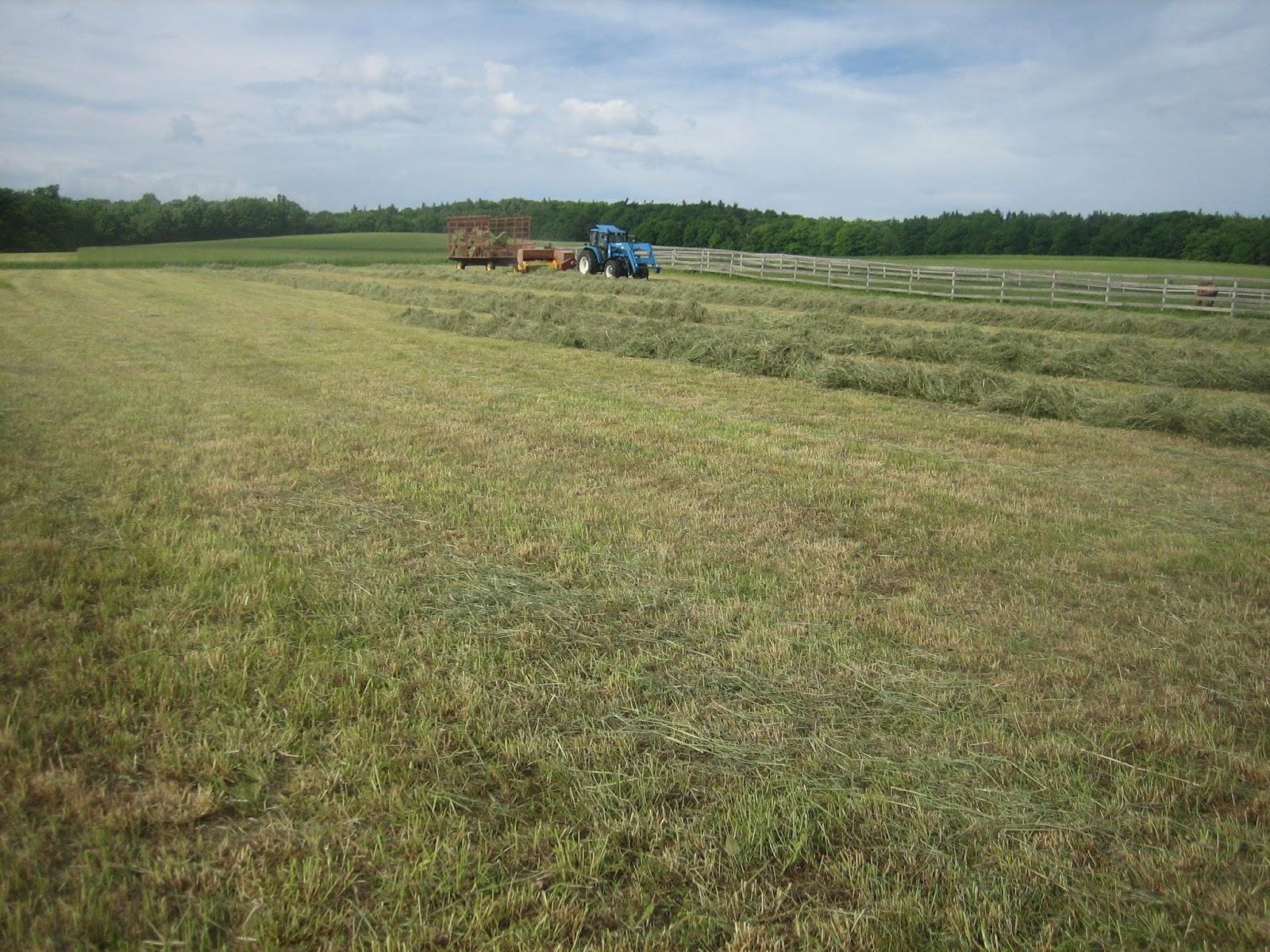
For those of us who make hay the old-fashioned way, we need to wait for at least three good days of clear, sunny weather with temperatures at a minimum in the high 70's. Cloudy days may slow down the curing process, although a strong breeze can dry hay nicely if the hay is already in windrows.

The haymaking process involves maintaining all the equipment and the capital costs of that equipment are high. When things need repairing parts are also expensive. A new gear box for a discbine for example can cost upwards of $2000, a new tire for a 100 horse power tractor over $2000! You get the idea. 

For the hay season much diesel will be required to run all the equipment, and the baler must be kept stocked with twine, which sells for about $30 for two spools. When you are baling hay, that cost adds up quickly.


The operator of the equipment must be well versed in handling large equipment often in tight spaces, know the complex process of levers and how to set up windrows, keep the baler feeding correctly with the proper groundspeed and know all the methods of setting up the equipment safely. Plus be prepared to jump out and handle any mechanical difficulties that might arise. Equipment only breaks when you are using it after all. Hours and hours of driving time are involved, and so labor costs also add up quickly.It is not uncommon to be driving from morning until dew time in the summer, in order to get the crop in when Mother Nature provides the opportunity with her sunny rays.

So the hay will be 'knocked down' or cut, then after the surface of the cut hay  has dried off it will be tedded or turned with a tedder/rake, usually within 24 hours. This procedure will be repeated on the 3rd day and if the hay is cured enough ( to less than 14% moisture content) it will be raked into windrows and baled. Of course those bales don't stack themselves, so if small squares are involved, which are the favorite type of hay for horse owners as they minimize risk of bacteria, (botulism especially), are easy to handle and to stack, someone has to unload those wagons and safely stack the hay. A conveyor is usually used, and the labor of throwing all that hay is hard work, even for the strongest of workers. So again, more labor cost is added to the cost of the hay.

Now to selling the hay. While word of mouth can be very productive, the farmer still has to advertise his hay for sale. Advertising costs money and time to keep the advertisements up to date. When the buyer arrives, the farmer now has to provide labor to load the hay onto the truck. If the farmer delivers, then naturally the hay will have to be stacked and transported and in many cases even stacked at the recipient's barn. The return leg of that delivery running empty will still cost the farmer fuel and of course this whole exercise takes time.

Throughout this process hay may be lost to errant bad weather. The hay will still need to be picked up and then thrown out or mulched back in which requires another machine and more machine time to go over the entire crop and break it down. Drought may impede the hay crop growth and leave the farmer short on quantity, and as a result you may see hay prices increase.

As you can see making hay requires a lot of hard work, is time consuming and as it is always hot weather when it takes place very often the producers are working in very high temperatures which may easily exceed 100 degrees in the barns when stacking high up.

The job is not without risk either. Insurance costs are expensive and the risk of injury or death is high, despite the best safety practices. Equipment malfunctions, a fall or bad step, tumbling hay can easily knock you off your feet and cause knee injuries, hands or clothing caught in equipment, rolling or falling equipment. The list goes on...

Between cuts the fields also need some care and attention. At our farm at Willowview Hill in Stamford, New York, we farm organically so we add manure to our fields to build back nutrients into the soil. From time to time we may add other natural products such as lime, to keep the soil in good health.

Other farmers use chemical fertilizers. Whatever is used it adds more expense. 

At our farm we also edge our fields by mowing them out twice a year, to ensure there is no encroachment on the professionally seeded hayfields of neighboring plants, weeds or tree saplings. If we have a tree come down, it is blocked and used for firewood and the remnants picked up and then the area is hand raked. No-one wants twigs in their hay or weeds either.


So next time your hay provider tells you they need an extra 25 cents a bale, think about it in a positive light. Farmers struggle to make ends meet as it is, and hay is not going to become any cheaper as land is swallowed up for development and farm space is lost. The day will surely come when small squares  of hay are simply too labor intensive to make and you'll need to buy special equipment yourself to handle the oversize round bales, invest in special feeders that will hopefully not injure your horses, get used to the wastage large round bales incur and push and lug the big rounds into your specially built barn. There won't be any opportunity to put them in a hay mall! Though you may end up storing them in plastic outside, which can cause a myriad of other problems with the preservatives and chemicals required.



Saturday, June 9, 2018

Horse Training Journal Protects the Horse Trainer

It is surprisingly common for horse owners to move their horses from one trainer to another in search of a quicker 'fix' to their horse's dilemma. Whether it is a young horse in training or an older horse that needs some remedial work, the process is one of individual attention and a proper program for a logical progression in the horse's understanding, trust and physical development.


Unfortunately for the horse trainer, the satisfied client is usually best obtained by providing fancy or quick results. Whether or not the work is truly correct, whether or not the work completely resolves a previous issue seems irrelevant to some owners. It may be their ignorance or it may be their need to sell off the horse for a handy profit that drives their impatience. Whatever it is, as a horse trainer it is smart to keep a journal of the workouts and schooling sessions you have completed, and narrate the progress of your program through a journal. Preferably, a video journal.

Paul Alvin-Smith, GP trainer at Willowview Hill Farm schooling ANCCE/PRE stallion Celesto IV in half-pass in 2015


Over 25+ years training horses I have learned to do just this. It is not only a great way to look at the progress of the horse under your care for yourself, but it also serves as protection from false claims made down the road by the next trainer in line.

Regardless of whether the horse has a show record or not, I always take a video of first sessions and then once a program has been decided upon with a list of short and long term goals, I video once a week to record how things are coming along. Before the horse leaves, whether the move was planned or a last minute decision by the owner, a final recording is done to show the work that has been put on the horse. Of course, if you have shown the horse for the owner meantime you will also have the show results as a permanent indicator or the work you have completed.
Rushed and incorrect training will show up in the show ring later.

The best owners to work with are usually those that ride themselves and have some experience in the realm or discipline in which you train. 

Some issues that come with horses such as broken crests, broken connection to the bit at the 3rd vertebrae for example, take a long time to work patiently and correctly to resolve. Other issues, such as lack of balance, nervousness at mounting are quicker and easier to improve. Every horse has his own questions and as a horse trainer it is up to you to prioritize the ones you need to fix first, working toward a goal and not doing a quick fix just to garner a quick score in the ring, that will not be sustained in the horse's career because the basics have been overlooked.
 
Working on a broken 3rd vertebrae takes riding talent and time

In my experience as long as you are always true to the horse and his well-being and understanding, and build the horse up properly to not only understand his job but be able to complete the tasks with the proper physical and mental development, then you will always be happy. Good trainers attract good clients. Don't worry about the 'chop and change' clients. They will find what they need elsewhere.

Down the road if false claims are made about who trained what on the horse and you want to address those claims, you have the evidence in your horse journal. Keep good records of all your dealings with clients and make sure you have them in writing. A good contract will protect now and in the future, if the need arises. 

Remember you train horses because presumably you are good at it and enjoy it. Many horse trainers enjoy their time spent with horses more than they enjoy their time spent with humans. Be true to yourself and be true to the horse you are working, you will never regret it.


Tuesday, March 13, 2018

Happy 6th Birthday to Catskill Horse Magazine

Catskill Horse magazine began as a community resource as an idea to bring together equestrians and horse lovers from all disciplines in Upstate New York.

At the outset we wondered whether the name should be more general to encompass any future growth past the Catskill region. We didn't know then how well received this all volunteer publication would become or the widespread geographic support and readership it would garner. 

The Merry Band at the Catskill Horse began as a small group of avid horse enthusiasts led by yours truly, who met in local restaurants for quick lunches to put together a program of responsibilities. Some took on sales and marketing, others wrote features and covered events, and the initial reception from local equine businesses was frosty. 

Whether the lack of enthusiasm from the industry was due to budget restraints on their end or their lack of confidence that a digital magazine would work six years ago or perhaps a mixture of both, I don't know. Whatever it was, there have been stalwart supporters of the magazine through advertising, sharing on social media of the columns and feature articles since those early days in 2012.

Today I am proud to report our visitors exceed 69,000 per month! The reach has grown to encompass not just Upstate New York and certainly not just the Catskill region, but also reaching into neighboring states. We even have some ardent followers abroad in the U.K., South Africa, Canada and Australia. 

The Merry Band at the Catskill Horse has evolved over time too. Some of our contributing writers have moved away, become too busy to write for us or taken on other tasks elsewhere. New folks come and join in, people from all walks of life, ages and geographic distribution. Everyone brings fresh ideas, new voices and our readership apparently loves it because they keep coming back and quickly become regular readers.


Renewing advertisers are truly the best indicator that their advertising spend with us results in increased branding for their products or services, increased trust in the integrity of their brands and increases sales. 

Sometimes trainers and horse folks in general are just so busy 'doing' everyday that they forget that if they don't keep up with some marketing effort their businesses will slowly decline, as their clientele moves, ages or changes focus.
It is our job to help them grow and our mission is to help the Upstate New York region develop its tourism business and maintain its beautiful bucolic farming landscape through horse farms and rural lifestyle development.

So far we have been successful in our endeavor to keep the magazine FREE to read and FREE to advertise in the Directory Listings and specialist areas such as restaurants, accommodations, job listing etc. 

We invite everyone to come join in! And remember, renewing advertisers receive a discount off our regular advertising rates.

Happy 6th Birthday to Catskill Horse magazine and sincere thanks to everyone past and present, for their support and contributions. 


Sunday, February 18, 2018

Horse Hay Woes

If you buy in a new hay supply and you find your horse is messing the hay about in the stall, you might automatically blame the quality of the hay.

While your horse's reluctance to eat the new 'batch' may indeed be due to a poorer quality product than he is used to enjoying, it is also true that he could just be letting you know that he is not happy that you've switched hay type or source.


For example, if you have a yearling Thoroughbred colt that you have been feeding an alfalfa/grass blend 2nd cut hay, then you introduce a good quality 2nd cut hay but he ignores the new hay and instead paws through it and won't eat at all or at best picks through it, then he is certainly complaining.

A horse does have an innate ability to 'complain' but in truth he is probably just protecting himself from a significant change in diet and the dire results such as colic, that could result.
His actions do not necessarily mean there is anything wrong with the new hay, just that it is not as palatable as the hay he previously ingested.

When a hay dealer or hay farmer delivers hay to your farm, stacks it for you and then takes a check in payment, it is important that you don't rush to judgement on the hay he has provided just because your horse is taking a while to adjust to the new provisions and rashly stop pay the check. Especially if the hay previously fed was full of yummy alfalfa. Give your horse a few days to adjust and always blend the new hay in with the old over several days to give your horse a chance to acclimatize to the new menu. Believe me he will adjust!

Similarly a horse that has become used to soft 2nd cut hay will turn his nose up at 1st cut which will provide more 'chewing satisfaction' but is likely not as sweet or soft to eat.

Always restock your hay supplies before you finish the last few bales so that you can blend the different types/sources of hay together for a period. This may prevent not just an upset with your hay vendor but also may save your horse from a colic episode. The equine gut needs time to adjust to the new digestive requirements especially by production of certain bacteria in the gut, to digest the new hay. 


Tuesday, December 5, 2017

A New Horse For Christmas?

The snow begins to fly and the shortest day of the year is around the corner. Yay! The New Year will soon be here and no doubt you will be setting new goals for yourself for 2018. Do those goals include doing more horse riding? Perhaps you used to ride and think about getting back into horses or perhaps you've been training at a lesson barn and think about buying a horse of your own? Perhaps your present horse is in need of retirement and you need to think about starting a new prospect?


A new horse for Christmas? Is that something you dream about? Of course the biggest concern is probably the budget. What can you afford? Should you go and look for a rescue horse, and do a noble deed or should you find an off the track Thoroughbred and give one a home? Or should you enter the horse market and search for a prospect.

In my experiences as a clinician I've seen a myriad of horses of all shapes, sizes and soundness. While I truly applaud the efforts of those that choose to rehabilitate a horse and realize sometimes this does work out well for both horse and rider, I would also suggest that if you are in search of a performance horse and competition partner, you may wish to consider buying just that. A horse that is bred to do the job you want. A horse that is a clean slate and not recovering from a soundness issue and does not have to overcome trust issues.

The reality is that your time is worth money. Time you spend working through physical and mental issues with a rehab horse will delay your progress and may even inhibit you from attaining your goals altogether. The recovery process for a rehabilitation case is also often an expensive option and one that may pay off or may be a dead end. The costs for chiropractic work, special shoes, working through past bad or poor training mishaps or issues, vet bills etc. all add up. Suddenly your inexpensive horse has become a giant drain on your bank account.

So if you are looking for that diamond in the rough and think you can beat the statistics and find a solid, sound partner for your high performance needs at a kill pen, auction, rescue or in someone's backyard go ahead. But be smart enough to realize that what you don't pay for in the beginning you may have to pay out down the road. 

U.S. breeders do a great job training and custom designing horses for specific disciplines. For my buck I'd start there. Believe me, your foray into your chosen discipline will go much smoother with a horse that is bred to do the job. But of course, as a horse breeder for more than thirty years in the Hanoverian, Dutch and Iberian marketplace, I would say that!

Fenix ( Furioso/Aktuell) my first warmblood purchased as a weanling...


Saturday, October 28, 2017

Joy of Joys. The NYS Equine Inherent Risk Law Signed

It has been a long and arduous road to success but finally it is here! Woohoo! Governor Cuomo signed the New York State Inherent Risk Law into reality. 

Many organizations have been stalwart in their push for this much needed bill. New York Farm Bureau and the New York Horse Council among others, have pushed hard for many many years, fighting the status quo.

With the exodus of corrupt lawyer politicians that have since been jailed or sentenced, the door was finally open for this bill, which has always had stellar grass root support, to finally pass. As a horse owner, horse business owner, and lover of everything equestrian life I give sincere thanks and kudos to all involved in supporting this bill and getting this job done.

What will it mean to the average horse lover?

Hopefully it will mean more availability to ride horses. Many horse businesses e.g. trail riding horse entities, have been forced to stop offering trail rides and horse riding opportunities because of ridiculously high insurance premiums that have prohibited their growth. These premiums, theoretically, should now become more affordable as New York horse businesses will be better able to compete for the tourism dollar with the offer or more services for the equestrian.

In fact tourism is a key reason that the bill passed. With the vast amount of open riding land, maintained trail systems and parklands, New York State offers the equestrian boundless pleasures on horseback. 

While the Inherent Risk Law does not mean that folks still can't sue for damages, (so keep those waivers signed folks), it does mean that the number of court cases and suits issued should diminish. It should also mean more favorable outcomes of law suits for the horse owner.

Many amateur riders that own horses say to me, " Why does it matter to me? I don't own a business?"

It does matter to you. If you want to conserve riding trails and openland for horse riding and horse keeping, the state needs to be horse friendly. If you don't want your riding lessons to cost an arm and a leg financially, then you want your local barn or boarding facility to be able to afford their insurance premiums. If you want others to provide shows, events and clinics for your enjoyment and participation at reasonable fees, then the insurance premiums need to be affordable. Many, many shows have disappeared as the costs to run them have skyrocketed on the insurance side.

Additionally most Homeowner policies do not cover livestock liability. So as a horse owner you may have thought you had protection that indeed you did not. As an amateur you can obtain coverage through membership of the New York Horse Council, still worth checking out.

Personally, I am extremely grateful to all that put in to secure this outcome. I urge you to support your Horse Council and other organizations that helped us with this win. Who knows what is next? Talk of making us license and register every horse, register every horse transport or movement, horse microchipping requirements by municipalities. The list goes on and will continue to grow.

Sunday, July 9, 2017

I have to admit it. I am a dressage geek!

I do have to admit it. I am a dressage geek. I simply love trotting about in circles, working on lightness in every step and then there are all the wonderful accoutrements. The soft buttery bridles with padded polls and nosebands, the bling on boots, the white polo wraps accentuating every stride. Oh. The fun of it all.

There are the mystical theorists, who claim to reinvent the wheel of dressage. The Germans, The Portuguese, The French, The British. It's all actually been done before. Explained before. Ridden before. Judged before. The grand old Masters and the new ones, the sport and the classicists. All of them bringing true essence to the world of dressage and oiling the wheel of dressage commerce.

But where are the $$ in competition? Why is this missing in this ancient discipline? Why for goodness sake is everyone still scratching their heads and wondering where are the sponsors.

I'll tell you where they are ~ home and not alone. In my experience working with many different companies who have gone into the arena giving prizes of all descriptions for a variety of events, the return on investment (ROI), simply is not there. It is not quantifiable at the very least. 

I can attest to many, many gift certificates that have been donated to events for prizes that are simply never, ever cashed out? It is like pulling teeth to have the dressage community get involved or show any loyalty whatsoever to a brand or sponsor. And I mean an old, infected tooth in an old horse's mouth that breaks off while you are trying to pull it. Riders sometimes win saddle pads and other gifts and quickly turn them around and sell them on Ebay. Not a problem. They won them after all. But there is no appreciation. No photos sent to sponsors. No thank-you notes. Event organizers sometimes have drawers full of unused gifts and certificates that they suddenly remember and give away randomly. 
Dressage needs to take a good hard look at events like HITS Saugerties who treat their sponsors as VIPs, sell their logo and brand at every opportunity.


The show is supposed to name sponsors. They will mention the sponsors over the tannoy they say. Doesn't happen. Not even when they know a representative of the sponsor is present on the show grounds. I've been to shows that promise a show program and been told at the gate they are all out and watch competitors sharing! What!!! Well worth the cost of that advertisement. NOT!

Eventing in Kentucky recently lost Rolex. Humm. Wonder what happened there?
Big sponsors and small have all had enough. There seems to be zero appreciation for the donations and the PR return is dismal. As a business it seems apparent you are far better off putting the funds into SEO and data collection, split tests and funneling. 

So big pat on the back for those that stick to it. As a competitor or event organizer realize this is going to become a bigger issue not a smaller one. Do the math. Can you hold that show without the sponsors??