Showing posts with label horse hay. Show all posts

Saturday, April 5, 2025

Canadian Hay In Your Barn??

If you buy hay from Canada to feed your livestock or in particular, horses, then you certainly know that a substantial price increase is highly likely in the coming months.  

Willowview Hill Farm, Stamford NY - Top quality horse hay organically grown and harvested in the Catskill Mountains of NY


Competition for hay sales from the Canadian market has always impacted U.S. farmers. At times of drought or extreme wet weather its import may have saved their bacon, but at most times the imports provide stiff competition for the farmers south of the Canadian border.

It is particularly difficult for farmers in States that are closest to this large production to compete with the imported hay that comes across the border. But it looks set for that to change.

As a New York horse hay farmer, I know keeping an eye on market forces is very important if our small farm is going to survive another year making artisan small square bales for the equine marketplace. There are many influences on hay prices and they are all set to promote higher prices as far as we can ascertain right now.

Mother Nature Can Be Kind Or Cruel


Aside from the imported hay competition, farms face many other rising costs. Not least of which is a 30% rise in insurance costs that has hit us again this year. Thankfully oil prices are lower. But repair costs for equipment are staggeringly high. And costs for fertilizer is even worse. As we farm organically the chemical fertilizer factor doesn't enter into our equation, but that is not true for most hay producers. Almost all round bales contain chemical preservatives too, so their expense will also need to be accounted for in the price.

Like many farmers we fix and mend what we can, but issues like a blown gear box on the discbine or a major tractor repair, can set a farmer back thousands and thousands of dollars, before the first blade of grass is even cut.

Hay equipment is expensive to buy and expensive to maintain


Of course, things don't break when you aren't using them, so we can expect more interruptions to hay production aside from the obvious one that is thrown at us every year by Mother Nature. The weather!

Like many, there is always the consideration to quit farming altogether. The demographic showcases that farmers are aging up and out of the business. It is sincerely hard work. And a roller-coaster experience of fighting with the weather, the machinery and the unknown factors that haunt the bottom line throughout the year can burn out even the most optimistic and hardworking individuals. It is a profession with a high injury factor and health risk too, and medical expenses are also through the barn roof for many.

So all in all I'd say take a good hold of the reins on your hay budget and expect a helluva ride. Because while we are bouncing about in the fields making hay while the sun shines, come Fall the clouds will be gathering as prices likely increase significantly. The only good news for hay farmers is that perhaps without the competition from large Canadian hay producers, they will have a shot at better margins for sales pricing overall to cover their own rising expenses.

When you see hay prices hit new highs, don't be surprised. Forewarned is forearmed. Stock up when you see good hay available on the market and buy the best quality you can to minimize waste. Don't fall prey to making false economies with poor quality horse hay that just brings a vet bill and a lot of mess to clean up come Spring. 

Come winter you'll need to be stocked up


Tuesday, January 21, 2025

Propionic Acid In Your Horse's Hay - Good or Bad?

Hey - What's in your hay?


Organic Hay Supplies At Willowview Hill Farm
 

Today, the vast majority of large round and square hay bales are baled utilizing the convenience of adding the preservative propionic acid. And small squares similarly are regularly harvested using the 'spray' or as some horse owners refer to it, 'pickle juice'. In fact, farmers claim large masses of hay cannot be cured without mold occurring post harvest without pickling, particularly if hay is conjured up into large bale format.

Of course large bales also pose other risks for horses if preventative measures are not taken. As most horse owners are aware, many veterinarians advocate giving horses a vaccine against botulism if they are likely to be fed large bales, as the presence of dead vermin or other wildlife is associated with the larger-sized bales.

Many horse owners report issues with their equines' health that they believe stem from the animals' ingestion of forage produced using this increasingly popular preservative. Equine health issues with loose stools, hind gut acidosis, EGUS {equine gastric ulcer syndrome} and various skin conditions such as hives being the most common observed.

There are other preservatives too of course, including some worrying ones that are are based on bacterial microbes being added to the hay. But propionic acid is by far the most widely used at the present time. 

If you look at toxicity studies of the chemical compound in animals far less sensitive than the horse when it comes to digestive health processes, it reads rather ominously.

Extract - read full report here
One of many horses bred at Willowview Hill Farm


The reality is that horse owners have little choice when buying hay if they want to avoid these chemical additives in the forage supply. 

Market forces result in a decrease in the number of farmers who grow/harvest and produce small squares organically. This is for many reasons. Realize that the organic nature of farming precludes adding chemical fertilizers to increase yields which lessens overall yields; the labor costs/machine time expenses due to the length of time it takes Mother Nature to dry hay the old-fashioned way - sun and dry weather are higher for the farmer not using time-saving preservatives; higher crop losses are inevitable due to inclement weather rolling in unexpectedly. 

It's not even just the preservative factor that horse owners need to worry about, it's also the grass seed that is sown. Hay producers increasingly rely on Roundup ready seeds, particularly for alfalfa that is notoriously difficult to harvest in a timely manner without mold developing. Spraying with herbicides and pesticides is not uncommon.

The other question is whether small square bales themselves are becoming artisanal products. A topic we explored here.

The word artisanal is defined as,
“Creating a product in limited quantities by traditional methods.”


It's all a bit worrying really. When you consider how essential dry forage is to horses. Grazing is simply not available year around or when the horse is stabled.

To be fair, there have been studies conducted more recently that suggest the addition of propionic acid to a horse's diet is not a big thing. However, the issue is who conducted the study and its limitations. It is certainly a questionable study.

Sadly, it is rather transparently obvious that the ongoing pandemic in EGUS and other digestive and resulting health maladies our horses suffer is very much based on the changes in the formulations of both grain and forage that we are feeding our noble beasties.

One of many horses bred at Willowview Hill Farm

As many of our readers know, I am a solid believer in keeping our performance horses as healthy as possible from inception/birth through their vintage years and home-produce and sell organically grown hay and have done for more than 20 years. 

Back in the late 1990's, issues with respiratory and digestive conditions in horses were extensively reported across the pond with reports and research suggesting causative factors where indeed chemical and preservative based. Hence our decision to pick up sticks and move to a property large enough to home produce hay for our then budding performance horse breeding business and competition horse resource pool for ourselves and for sale to international level competitors.

Giving a horse a good start is so important, and keeping his gut health optimized is essential. When you consider the stressors today's equines are exposed to keeping them happy and well is harder than ever.

Look hard at what you are feeding your horses and know the provenance of it. Test your hay to ensure it doesn't include anything out of whack or nefarious. Be aware that you cannot smell or easily detect some of the elemental preservatives on the market yourself without some chemical analysis. 

If you are saddled with the only option being to purchase mold-free but heavily preserved hay, then consider adding a postbiotic product ( not a pre or pro), and learn about the digestive processes of your horse so you have a working knowledge of its needs and effects of it becoming sub-par and what you can do about it.

Shop artisanal if you can. It's the only way the labor of love diehard farmers who continue to produce organically grown and harvested hay will still be around. When you find an honest source, stick with it.

Willowview Hill Farm, Stamford, NY 


Wednesday, August 2, 2023

Experts Warn To Stock Up On Horse Hay Needs

It doesn't come as a huge shock to hay producers in the country to hear experts warning horse owners to stock up on their forage needs early this year.


Organically produced hay growing at Willowview Hill Farm, Stamford, NY

Take the recent press release by Coleman, University of Kentucky Extension Office -

"Coleman emphasized that hay is a mobile commodity. Although hay may be readily available in some areas, regions experiencing a shortage will require hay to be transported across the state or county,” he said. “Making hay purchasing decisions early can ensure buying at a reasonable price when the supply is abundant. Waiting until later in the feeding season might lead to reduced availability and significantly higher costs.” (read more on our news page)


Here in the North-East we've enjoyed the wettest July in nearly 200 years, 197 to be exact, and the 3rd wettest month in 197 years with over 11.5 inches in Upstate regions of New York. Staggering metrics for sure, and as any hay farmer knows not only has Mother Nature dished out heavy rain this growing season, she has also spent this season offering tantalizing day of sun followed by a day of rain. 

Finding horse hay of 2nd cut supply wise will be hard as quantities will necessarily be low due to the late 1st season harvest. Finding 1st cut that hasn't been wet in the field will be equally hard. 

The reality is that many farmers through sheer frustration turned to silage as a means to get hay harvested at all. While others have relied on the bevy of (untested for safe use on horses) dry-down agents and preservatives to cure hay sufficiently to prevent it causing fires, molding and dusting etc. Adding 'organic' acids does not mean that the final product can't cause horses health issues just because the word organic is in the title.

The other concern is that soaking or even steaming the hay that is infused or coated with these dry-down agents will likely not remove them from the forage. It is also good to realize that almost every large round bale of hay will have been treated in some manner to try and negate mold, dust or other issues in these so called 'ton' bales. It is simply almost impossible to bale these mammoths without their use.
Health issues that are likely to be prevalent in horses exposed to 'treated' hay crops can include hives, upper respiratory inflammation (especially in young horses), and that bane of every horse owner at this point, ulcers.

Digestive issues in the horse naturally manifest themselves in a variety of issues. Leaky gut syndrome, hind gut issues in general, lack of condition or poor behavior, muscle soreness and lameness, skin issues etc. The list goes on.

There are lots of good reasons to feed supplements to counter the effects of the negative diet and nutrition in the horse, but of course not putting the a horse's health in jeopardy in the first place would be ideal. This is trickier than it seems, as finding good quality well cured hay that is cured the old-fashioned way, by Mother Nature alone, is hard to do. When you do find it, it is likely more expensive than its counterparts and the absence of dry-down agents or preservatives does not mean it is good hay. 

Hay also needs to be clean and green, meaning clean of weeds, dust and mold and green with good color notating a proper time of harvesting and method of drying to the correct moisture content has been executed.

Many folks turn to feeding bagged, commercially produced forage made by large companies such as Standlee (Tractor Supply a likely purchasing point). If you read the print on the label and website, they do indicate that the hay they utilize has been treated with preservatives etc.

The likelihood is that hay produced to date will be quickly snapped up by hay dealers who have both the storage to hold large supplies in reserve while the market is built up to high demand and highest prices can be attained with accompanying robust profit margins. They can move the hay wherever the best price will be paid, often out of the area it was produced. 

Sadly it is not usually the farmer that reaps the profits of the hard labor it takes to produce hay. So in response, farmers across the U.S.A. have plowed many hay fields under for more profitable crops over the past several years. A practice that continues to show no sign of stopping its upward trending popularity.

The extremely high costs of fertilizer mean that yields are likely down. Utilizing 'liquid gold' cow manure or other animal manure spread on the fields after 1st cut to bring on the 2nd cut is common practice. But the organic manure will also bring with it a myriad of unwanted seeds from weedy or obnoxious plants. 

The small square, user-friendly, organically grown and harvested hay supply is ever diminishing and the reality is that as Coleman at UK quoted in his press release above, the best time to set up your hay supply is now not later. If you don't have proper storage then its wise to think about making an investment in that area too. 


Saturday, March 5, 2022

Keeping a Weather Eye on the Hay Market


As the snow starts to thaw and deer arrive back on the hay fields many farmers are planning their 2022 planting program. 

The steep increase in grain price means many hay farmers will think twice about keeping their fields under grass this year.

Diesel costs have skyrocketed, as have prices for fertilizer, machine parts and labor. Of course these price increases don't just affect hay, they affect grain prices too. Due to the war on Ukraine, a country that supplies 12% of the global output of grain, we will see increased in food costs not just for horses, but for people too.

Any hay reserves from 2021 have long since vanished. Despite the increased hay expenses, horse owners have little choice but to pay the premium rates especially if top quality hay is wanted. If like me you are looking for a new horse or two, it might be well to wait a bit, because the ridiculously high horse price market post the Covid pandemic is a bubble very likely to burst, as sadly people are forced to part with their horses as a result of the increased expenses of ownership.

Ulcer prevention, digestive health in general and overall mental well-being in horses are all significantly impacted if hay is replaced by products that offer less chewing satisfaction and less fiber quality and mass. 


At our organic horse hay farm at Willowview Hill Farm, our Catskill hills are already showing signs of Spring grass. The deer are already feasting on our crop. It's funny they go almost nowhere else in the valley to graze. I believe the organic nature of our fields is the reason why. Of course this means sharing our crop production with many 'Bambis'. Cute as they are, my husband worked out the amount of hay that one deer consumes at one point. It was a depressingly large amount from the perspective of hay income to the farm. 


But live and let live I suppose. I am already used to sharing any trees I plant and any shrubs or flowers I dig in to the garden with deer, voles and rabbits.

So the question becomes, should we continue to harvest hay or turn to other forage production. Especially as we have recently retired from horse breeding and simply don't need as much hay supply for our own horses. The amount of overage we sell has increased as a result, but baling small bales is a tremendous amount of work especially for my husband and myself to handle alone. 

One field of hay would easily suffice for our horses' needs. And frankly having more room to ride in the indoor arena instead of having to stack and store hay would be great.

It takes us a solid month of daily work to complete the first cut, and another 3 weeks to complete the 2nd cut. That does not account for the time it then takes to load and sell hay out of the barn throughout the year or service the equipment. Vacations, other income producing jobs such as clinic giving and horse training have to take a back seat when hay season rolls around. And you never know exactly when you'll be able to get busy on the fields so making plans to get other activities done is always a challenge.

 
Of course once the hay is harvested the grass fields are perfect for riding. Cantering around the outside of a field is less enticing than galloping over it. Once the grass is turned under, rocks will appear across the ground surface and if we ever want to return to hay cover then the rocks will have to be painstakingly picked up. The memory of that laborious task still lingers from 20+ years ago.

It's all fodder to ponder. 

In the U.K. fertilizer prices are up to 1300 UKL per ton. Similar increases are expected here in the U.S.A. Farmers across the country are turning to 'liquid gold' to fertilize i.e. cow manure. However, as hay farmers know, cow manure means weeds in the hay. At our farm we use horse manure to recycle and help re-balance the nutrients within the soil, along with organic mineral products such as lime.

The price of all hay will certainly increase again this year. Costs for production are ridiculously high. Horse owners are left with little choice than to pay up if they want first class hay that has been properly cured and managed.

Turns around the field don't come cheap with diesel prices at an all time high. To cure hay takes several rounds of work. The initial cut, a minimum of 3 turns between tedding and windrows and then the baling round. 

So my advice to all horse owners out there or barn managers that have to stock up for their clients' horses needs is to plan ahead. 

For boarding barn operators the hay budget won't go as far this year so boarding barns should think about increasing boarding rates now to cover the extra costs.

Sidebar: Here is a link confirming the above hay prices (focused on alfalfa production) from the USDA


Tuesday, July 20, 2021

The 2021 Hay Season Rained Out

Labor intensive small square bales at a premium
 

2021 has been a year of tremendous variance in haymaking weather for many hay farmers across the country. While the West has ridiculously hot weather, fires and parched ground, the North-East began the hay season with good weather and everything looked perfect for a great hay season.

In the Mid-Atlantic States the heavy rains in Spring brought on growth but also caused mildew issues with Bermuda grass types, leaving the Carolinas with less quality in their May cut. While in the North-East the farmers who dutifully watched the weather and started cutting as soon as the weather settled were rewarded with good quality harvests and slightly above average yields for the most part. But then the rains came and many farmers in the North-East and Eastern Canada were cut short in the 1st cut harvesting program. 

Organic horse hay at Willowview Hill Farm, Stamford, NY


In some North-Eastern USA regions, the daily rainfall totals have been so high and so overwhelming with their persistence, that the fields are too wet to even contemplate working at the present time. Yet, rather unusually, in certain areas such as Northern Maine and Northern New Hampshire and Northern Vermont, drought conditions have left fields of parched crop as their Spring rains never showed up.

Where rain persisted, many farmers opted to take the planned 1st cut dry hay as a silage cut, in order to hopefully maintain a decent 2nd cut yield later in the year. Due to the drought issue in Northern NE areas, hay producers in Upstate New York and Eastern Ohio are busy supplying their colleagues in those regions.

Meantime, hay commodity futures continue to escalate, as many of the usual hay producing States out West such as Idaho, as well as Northern PA, New York and New England report shortages are expected. Export hay prices are also increasing, with export levels above last year's numbers for the same period.

Top quality or premium horse hay production will obviously be negatively affected by the wet weather issues. If they have been harvested there is a likelihood knocked down hay will have at some point in time been rained upon, that necessarily lessens the nutritional value of the cut. Damaged crop may be mulched back or baled in large rounds/squares for use and sale to the cattle or general livestock market and miss the horse market altogether.

Even if the hay available is 1st cut, expect these later 1st cut supplies to be at a higher price than those available earlier in the year as a result of the high demand. Late cut 1st hay often means a lack of 2nd cut hay too, as the grasses have not had time to grow. The outcome of 2nd cut yield and quality will depend of course on the amount of rain and temperatures.

Given all the above it is a good idea to stock your barn with hay supplies sooner rather than later, or be prepared to pay higher prices again this year. Diesel prices are of course significantly higher than 2020 and many farmers are still reeling from last year's drought and lack of hay revenue as a result and have barely managed to stay financially afloat. Many having to buy in hay supplies for their own livestock instead of supplying their own.

Current prices that dealers are paying for small square 1st cut horse hay bales of premium quality in Upstate NY range from $6-$8 bale. Dealers are already scooping up supplies, having learned the lessons of last year in the supply chain. While certain areas such as Long Island, NY, NJ, PA, and the entire North-East are paying much higher prices. Some retailers paying as much as $13-14 for a small square of good quality product.

As for the availability and pricing of 2nd cut - expect that to be elevated and talk to your suppliers early. Consider buying hay out of the wagons/off the field to secure supply.


Tuesday, October 6, 2020

Buying Horse Hay? Beware of Scammers...

 As Fall is in full swing and winter rapidly approaches horse owner's thoughts turn to stocking up on hay supplies. It seems there are an abundance of scams ongoing, some new and all nefarious and many occur through social media entities such as Facebook, where folks seeking hay are 'trolled' and captured.


Here are a few tips as to what to look out for so your hard earned dollars don't disappear without quality hay 'on your table' and red flags to be aware about when resourcing a supplier.

  • Know your supplier. Do your due diligence when it comes to buying hay. Obviously there are many reputable hay dealers around, but there are also many that are not and many middlemen that act in concert with certain hay dealers procuring hay supplies and customers for a commission that actually produce no hay at all themselves, or very little. It is smart to know the provenance of your hay if possible, and deal directly with the actual producer of the hay. Dealers necessarily source hay from all over the place and quality can vary considerably. At a minimum a hay seller should have a website, and a decent and transparent online presence. Be aware that middlemen often use other people's photos of hay stacks and claim them as their own, when really they have no such production or supply on hand.
  • Don't pay in advance. The latest trend of taking/requesting 'bookings' and requiring a deposit or prepayment is a great way for dealers to garner cash from prospective customers to provide cash flow to their business. How do you know you will even see the hay? There have been recent arrests ( finally) of a person in VT that regularly took money from unsuspecting horse owners for loads of hay in advance of delivery for many years, and never turned up with any hay supply. If you prepay you also have no idea what quality will be provided or when it will arrive. Pay on delivery.
  • Check the load. Dealers may tail load with good hay, so that on initial inspection the load looks good and you say go ahead and unload it. Halfway through the load may be a different quality from a different source. Check it throughout and ask the dealer if the hay has all come from the same producer.
  • Watch out online. There are many folks that pose as prospective consumers or direct growers when really they are middlemen looking to either pick up a load and add their margin, or are resourcing prospective customers for larger hay dealers. Larger hay dealers may even drop a trailer at one of their 'sales agents' and ask them to fill it by finding a source of hay, and then call on it when they get a call for someone in the area needing a hay supply. Thus your hay may have sat in a metal tin for a while before you see it. Not good for the hay!
  • Stay loyal. When you find a good resource to buy hay stick with it. Understand that prices may nominally increase year to year as all farmers' experience cost increases annually in producing the hay. Insurance, fuel, equipment leasing, buying and maintenance, costs to fertilize fields either organically or with chemicals, re-seeding of fields etc. 
  • If you are looking for horse quality hay, buy from someone who knows horses and what their needs are. Properly cured horse hay, grown for horses without weeds i.e. clean and green, will cost more than cow hay.


Sadly there are many unscrupulous people out there. Be smart, do your homework, call and ask questions, Google them, review websites and social media posts. 

Don't part with your cash until you have seen the hay in person and are happy with it!


Tuesday, July 28, 2020

Hey! Need hay? Update on Horse Haymaking for 2020


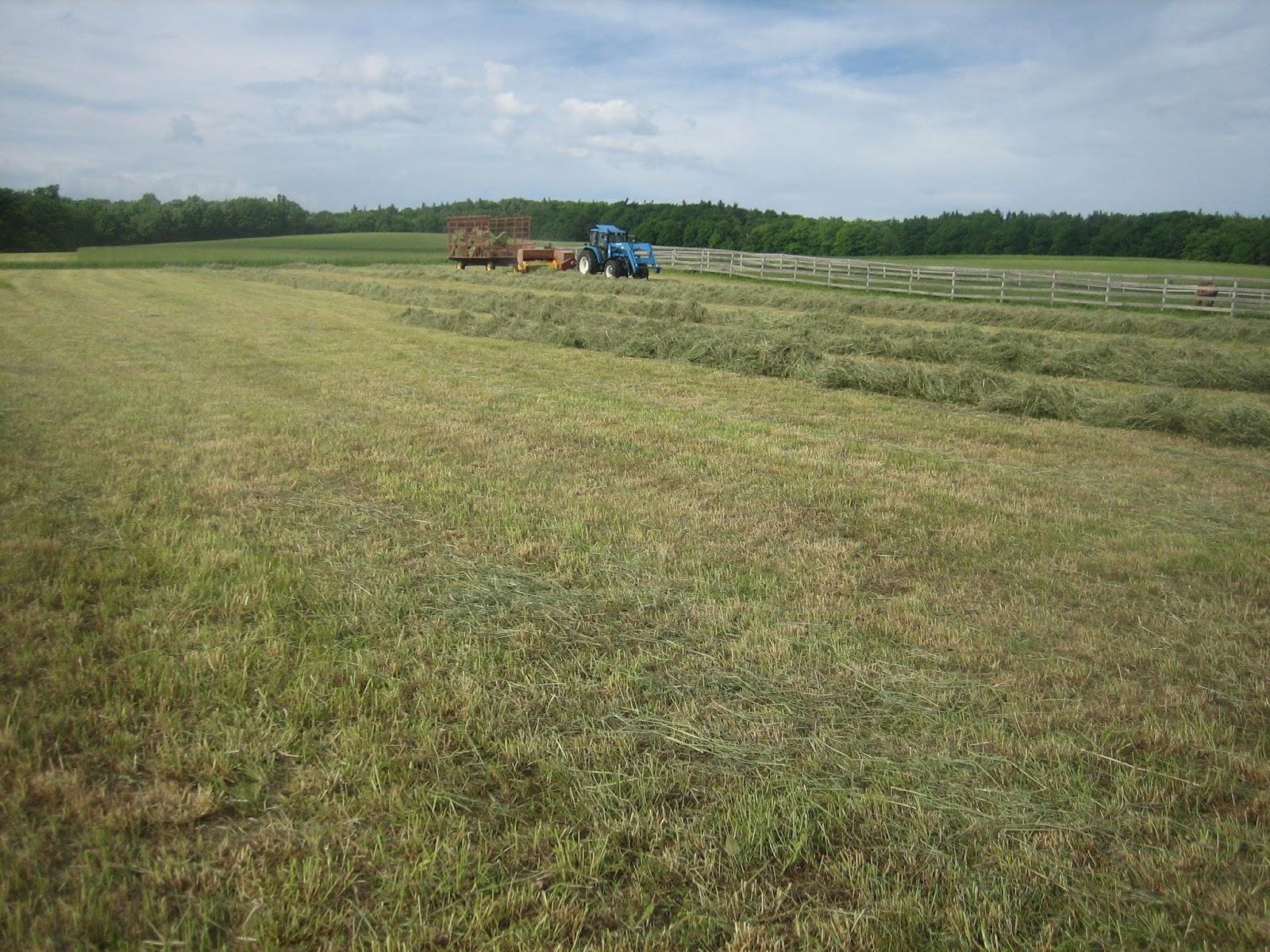
1st cut 2020 hay - Photo Courtesy of Willowview Hill Farm, Stamford NY.


Farmers are busy baling hay and closing out their 1st cut 2020 season. The weather has been difficult this year and yields are down for 3 reasons:

  1. The late start to Spring weather and lack of snow cover over winter dished out a slow start to the growing season for all types of hay.
  2. The lack of Spring rains cut down on the yield.
  3. The good weather had farmers taking advantage of the opportunity to get busy knocking down hay earlier than usual so many of us saw a lower yield.
What does this mean to the consumer looking for 2020 1st cut hay?

Yields being down 30-40% in some cases mean hay prices have seen an increase according to the USDA.

The hay available is of very good quality in general, as most farmers did cut earlier so the seed heads are still on the grasses and the stems soft. The drier weather also helped hay producers avoid rained out haycrops on the field in the NE USA so the nutritional quality should be higher.

The earlier hay cutting opportunity also means many cow farmers are taking advantage of a midsummer 2nd cutting for silage and will take their usual 2nd cut as a 3rd cut later in the season. This may mean the horse hay available on their second baling will come in later and may suffer from curing issues with the hay lessening quality if pushed too late into the Fall. 

When less 1st cut is available customers will be forced into buying more expensive 2nd cut that is around. Either way - 1st cut may be harder to come by if you don't stock up with enough for winter and have to start searching high and low for it in the Spring. 

Rainfall in July in the North-East has not been significant so we wait and see how yield on the 2nd crop comes in. 

Photo Courtesy: Willowview Hill Farm, Stamford, NY

All in all it would be smart as a consumer in need of horse hay supplies, to stock up sooner rather than later to ensure supply needs can be met and hay costs are kept under control.

Tip: If you choose to buy large rounds or squares consider buying an equine hay feeder as they can save you up to 30% on hay costs according to University of Minnesota research.


Photo Courtesy of Horizon Structures LLC, Atglen, PA


Wednesday, August 14, 2019

2nd Cut? What 2nd Cut?

If you are a hay farmer you are not alone in starting to panic about whether or not you are going to get any 2nd cut in the barn!

Thankfully, our 1st cut is secured!


The late start to the 1st cutting season due to the wet and weird weather in the North East has meant that the 2nd cut is not at the height we would all like it to be. Add to that the unusually cool temperatures for August you might expect that as grasses generally like cooler weather the grass would be on a march skyward. Not so much. 

A recent sortie around our hay fields showcased some very slow growth, though admittedly we do not add chemical fertilizers after 1st cut is taken off the fields so our 2nd cut is not as robust as some other farmers might enjoy.

As we look forward to the 3rd week of August no haymaking weather is in sight for the next 10 days. Even then, temperatures are only in the mid to high 70's here, questionable usefulness for curing hay without preservatives. As an organic horse hay producer we rely on Mother Nature to provide all the curing factors for a great crop. So yes, we are beginning to get a little edgy at the prospect of a) a reduced crop b) will we be able to get in any 2nd crop at all?

As busy dressage clinicians hubbie and I have a host of scheduled appointments including some travel that involves booking international flights to our hosts in Portugal and Spain. We have horses to visit for clients that are currently available for sale, but judging by how long it is taking us to confirm our travel arrangements we may have to start over with a new review of prospects before we hop on a plane. Due to the haymaking issue that looks like it may stretch into early September and even mid September, all those plans are on hold. 

My hubbie Paul, trying out prospects at Stal Andre, Lisbon. Home of Antonio Monterio Borba.
Meantime our dressage colleagues in Portugal and Spain are desperate, as usual, for rain. Fire is a constant threat to property in these countries, and it is always worrisome when you own property there especially as fire insurance is restrictively expensive to purchase. 

Dry weather is a constant source of concern in Portugal and the Iberian peninsula in general

Of course on the plus side, and there is always one, the problems with petrol/gas supplies for motorists due to the striking oil/diesel/gas tank drivers in Portugal will hopefully be cleared up by the time we get there. Clinics involve a lot of driving about between venues and it is not unusual for Paul and I to drive many miles in our rental car, from Lisbon up to Santorem and North past Coimbra, before heading South all the way down to The Algarve and then across to Seville and down to Cadiz and Jerez. Lack of fuel supplies would make that impossible. 


We usually fly to Lisbon and head out from there

We have a few clients in Estoi and this Pousada Palace is the perfect place to stay

In Loule, The Algarve heading out to Villamoura


It is frustrating for all involved to say the least. Our 2nd cut customers call us for updates and are also nervous that with the reduced amount of 1st cut available due to so much grass having gone to haylage and not dry baling due to the weather, and the lack of 2nd cut hitting the market, they may be caught short on supply options.

So please Mother Nature, thanks for all the rain and cool temperatures to help make the 2nd crop grow, but could you please dish us out about 9 days of 85 degree weather toward the end of August?


Thursday, August 16, 2018

Anyone Else Worried About 2nd Cut Horse Hay Availability?

In the last several days we've received daily calls from hay dealers anxiously trying to track down any 2018 2nd cut horse hay. I guess usually by this point folks have started that 2nd hay cut rolling and bales are ready for sale. Not this year! In fact on our farm we are busy riding our dressage horses around the hayfields when normally we'd be in the tractor knocking down hay.

The incredible amount of rain that much of the East Coast and certainly Upstate New York has received, has made the grass grow rapidly, which is wonderful for folks like us who produce our own organically grown horse hay and market thousands of small square bales to horse owners. 

However, as we hit the middle of August, with no clear 3 day minimum dry weather pattern and above 80 degree temperatures in the forecast, you do begin to wonder if you'll ever be able to harvest all that beautiful grass that is presently being enjoyed by a healthy sized deer population.

My husband, being the mathematician he is, figured out that the deer population on our South facing tillable land gobbles up the equivalent of approximately 10 bales of hay a day, while the grass is standing. While sharing our crop with herds of deer is fine, it would be neat to know that we will have an opportunity before the end of August to work the fields ourselves and get that 2nd crop in the barn! 


When you see all the devastation that flooding has caused in the area and the fires and scorching weather that the Western USA and Europe is experiencing, I do reflect on how lucky we are to live where we live, and am grateful that we have had plenty of rain. Fortunately, our '100 year' rain swales that the Catskill Watershed folks put in over 20 years ago, keep our property free of flooding and send that water to the NYC watershed pipeline for use by our neighbors to the South.

The 1st cut hay season was exceptionally good for most hay farmers like ourselves, so if 2nd cut does become a problem, at least we won't be stuck like the Australian farmers paying $10,000 for a 20 ft ocean container of hay. Even if you don't usually feed 1st cut horse hay, it might be prudent at this point to stock up on some 1st cut, just in case the 2nd cut does show a shortage this year.

Counting our blessings for sure. But Mother Nature if you are listening, could we please see 6-7 days of dry, warm weather before September so we can get to work!


Tuesday, July 17, 2018

Why Does Horse Hay Cost So Much?


Hay season is in full swing and the hot and dry weather has many farmers happy with their well stocked hay barns full of delicious cured 1st cut.


While some farmers use preservatives and chemicals to cure their hay, many horse owners prefer hay that is cured the old-fashioned way, Mother Nature. The problem with preservatives and chemicals that are sprayed by either the cutter or the baler onto the hay is that many of these products, if indeed not all, have never been tested for safety in horses. Many have never been tested for safety in cows or other livestock either. However, the quicker baling turnaround time means less time spent turning/raking hay and less machine hours that use expensive diesel and add to the labor costs.

For those of us who make hay the old-fashioned way, we need to wait for at least three good days of clear, sunny weather with temperatures at a minimum in the high 70's. Cloudy days may slow down the curing process, although a strong breeze can dry hay nicely if the hay is already in windrows.

The haymaking process involves maintaining all the equipment and the capital costs of that equipment are high. When things need repairing parts are also expensive. A new gear box for a discbine for example can cost upwards of $2000, a new tire for a 100 horse power tractor over $2000! You get the idea. 

For the hay season much diesel will be required to run all the equipment, and the baler must be kept stocked with twine, which sells for about $30 for two spools. When you are baling hay, that cost adds up quickly.


The operator of the equipment must be well versed in handling large equipment often in tight spaces, know the complex process of levers and how to set up windrows, keep the baler feeding correctly with the proper groundspeed and know all the methods of setting up the equipment safely. Plus be prepared to jump out and handle any mechanical difficulties that might arise. Equipment only breaks when you are using it after all. Hours and hours of driving time are involved, and so labor costs also add up quickly.It is not uncommon to be driving from morning until dew time in the summer, in order to get the crop in when Mother Nature provides the opportunity with her sunny rays.

So the hay will be 'knocked down' or cut, then after the surface of the cut hay  has dried off it will be tedded or turned with a tedder/rake, usually within 24 hours. This procedure will be repeated on the 3rd day and if the hay is cured enough ( to less than 14% moisture content) it will be raked into windrows and baled. Of course those bales don't stack themselves, so if small squares are involved, which are the favorite type of hay for horse owners as they minimize risk of bacteria, (botulism especially), are easy to handle and to stack, someone has to unload those wagons and safely stack the hay. A conveyor is usually used, and the labor of throwing all that hay is hard work, even for the strongest of workers. So again, more labor cost is added to the cost of the hay.

Now to selling the hay. While word of mouth can be very productive, the farmer still has to advertise his hay for sale. Advertising costs money and time to keep the advertisements up to date. When the buyer arrives, the farmer now has to provide labor to load the hay onto the truck. If the farmer delivers, then naturally the hay will have to be stacked and transported and in many cases even stacked at the recipient's barn. The return leg of that delivery running empty will still cost the farmer fuel and of course this whole exercise takes time.

Throughout this process hay may be lost to errant bad weather. The hay will still need to be picked up and then thrown out or mulched back in which requires another machine and more machine time to go over the entire crop and break it down. Drought may impede the hay crop growth and leave the farmer short on quantity, and as a result you may see hay prices increase.

As you can see making hay requires a lot of hard work, is time consuming and as it is always hot weather when it takes place very often the producers are working in very high temperatures which may easily exceed 100 degrees in the barns when stacking high up.

The job is not without risk either. Insurance costs are expensive and the risk of injury or death is high, despite the best safety practices. Equipment malfunctions, a fall or bad step, tumbling hay can easily knock you off your feet and cause knee injuries, hands or clothing caught in equipment, rolling or falling equipment. The list goes on...

Between cuts the fields also need some care and attention. At our farm at Willowview Hill in Stamford, New York, we farm organically so we add manure to our fields to build back nutrients into the soil. From time to time we may add other natural products such as lime, to keep the soil in good health.

Other farmers use chemical fertilizers. Whatever is used it adds more expense. 

At our farm we also edge our fields by mowing them out twice a year, to ensure there is no encroachment on the professionally seeded hayfields of neighboring plants, weeds or tree saplings. If we have a tree come down, it is blocked and used for firewood and the remnants picked up and then the area is hand raked. No-one wants twigs in their hay or weeds either.


So next time your hay provider tells you they need an extra 25 cents a bale, think about it in a positive light. Farmers struggle to make ends meet as it is, and hay is not going to become any cheaper as land is swallowed up for development and farm space is lost. The day will surely come when small squares  of hay are simply too labor intensive to make and you'll need to buy special equipment yourself to handle the oversize round bales, invest in special feeders that will hopefully not injure your horses, get used to the wastage large round bales incur and push and lug the big rounds into your specially built barn. There won't be any opportunity to put them in a hay mall! Though you may end up storing them in plastic outside, which can cause a myriad of other problems with the preservatives and chemicals required.


Sunday, February 18, 2018

Horse Hay Woes

If you buy in a new hay supply and you find your horse is messing the hay about in the stall, you might automatically blame the quality of the hay.

While your horse's reluctance to eat the new 'batch' may indeed be due to a poorer quality product than he is used to enjoying, it is also true that he could just be letting you know that he is not happy that you've switched hay type or source.


For example, if you have a yearling Thoroughbred colt that you have been feeding an alfalfa/grass blend 2nd cut hay, then you introduce a good quality 2nd cut hay but he ignores the new hay and instead paws through it and won't eat at all or at best picks through it, then he is certainly complaining.

A horse does have an innate ability to 'complain' but in truth he is probably just protecting himself from a significant change in diet and the dire results such as colic, that could result.
His actions do not necessarily mean there is anything wrong with the new hay, just that it is not as palatable as the hay he previously ingested.

When a hay dealer or hay farmer delivers hay to your farm, stacks it for you and then takes a check in payment, it is important that you don't rush to judgement on the hay he has provided just because your horse is taking a while to adjust to the new provisions and rashly stop pay the check. Especially if the hay previously fed was full of yummy alfalfa. Give your horse a few days to adjust and always blend the new hay in with the old over several days to give your horse a chance to acclimatize to the new menu. Believe me he will adjust!

Similarly a horse that has become used to soft 2nd cut hay will turn his nose up at 1st cut which will provide more 'chewing satisfaction' but is likely not as sweet or soft to eat.

Always restock your hay supplies before you finish the last few bales so that you can blend the different types/sources of hay together for a period. This may prevent not just an upset with your hay vendor but also may save your horse from a colic episode. The equine gut needs time to adjust to the new digestive requirements especially by production of certain bacteria in the gut, to digest the new hay. 


Wednesday, June 15, 2016

A Dying Breed: The Small Square Hay Bale ~ Horse Hay

It is pretty amazing when you think about it. Take two people, a hundred tons of horse hay in small squares and pull it off hay wagons and stack it ready for winter. That's what we do at Willowview Hill Farm. Two people, pushing 60 - well O.K. now one is 60 and the other 57 - but still. Kids are grown and flown the coop eons ago. Spread across the Northeast USA with an occasional weekend day to come home and empty a couple of wagon loads, the hay season requires some guts for very little glory.


A conversation with a local farm mechanic who services many many farmers in the Catskill region was revealing. He knew almost no-one that still does small squares.

"Sure, I know cows not horses. I know the big bales are bad for horses. But cheap horse people buy them," he says, the early morning sun beats down on his dark locks and his accent is foreign.

No-one wants to handle the small bales anymore. Sure, the baler is approximately S35,000 instead of $90,000 to get a farmer started. Yet still, the small square farmer is a dying breed. And let's face it, the workload is humongous. The capital for the equipment needed even without insurance is over $100,000. for a reasonable size baler/cutter and turner plus wagons.

So the round hay baled for cows, with high moisture ( equals dust), a higher level of dead critters ( = botulism), is becoming more and more common around horse farms.

Horses become trapped in the huge metal hay racks, designed for low energy short legged cows not horses. Foals in particular are susceptible to damage this way. The hay is mostly wasted, because the horse is a picky eater. For good reason. Pay the vet or pay for hay we used to say.

In today's market the small square bale may fetch $4.50-$5.50 in the Catskill region. Take off the diesel cost, the machine wear and tear, the man hours operating and servicing equipment, the small windows of great weather for horse hay curing ( without the 20 chemical/preservatives that can affect horses and are completely untested on horses), the labor to stack, the building to stack the hay up properly and then the time to re-load the tractor trailer or end user with a horse trailer, and you have yourself a very expensive and labor intensive program.

If you are buying hay or making hay please do yourself a favor and read the 7 Deadly Sins of Haymaking. If you don't have this information you may be the first on the call line for the Fire Department.

The farm equipment mechanic told us that we are one of the last farmers he knows of in the area that puts up small squares.  And farm work as we know is very dangerous.  Last September when my husband was servicing the baler, the chain caught the oil rag he was holding and sucked his hand into the multi-chain mechanism resulting in a severed thumb. We have had many close calls over the years. One time another mechanic had switched up the parking brake to make a repair and had not properly reset it. When my husband hopped out the tractor with the brake on, to remove a bale that had escaped the wagon, the whole rig proceeded to move slowly forward. It inched and gained speed. He was between the baler and the wagon. Thankfully some guardian angel must have been present because I saw it start to go and shouted to him. He ran after it and managed to scale the steps and stop it. Not something I'd recommend as that in itself is dangerous. But these things or versions thereof happen every year. You must always be diligent. When you think everything is OK then you are headed for trouble. 'Familiarity breeds contempt,' as the saying goes. Even though we are avid horse breeders/horse people and know the benefit of the small squares, even we have looked at round baling our crop.

So when you head out in search of some high quality hay for your horses this season please take time to think about what effort for very little financial return has gone into the production. Small squares will not be around for ever. The workload is just too hard and the costs too high.


Tuesday, June 16, 2015

Hay! Hay! Hay! Frustrated Yet?

Everyone's level of frustration with Mother Nature's present weather pattern in the North East is rising along with the level of the water table. The fields of green toss their mane of grasses tantalizing the farmer to come knock them down. Farmers phones ring off the hook with calls from hay dealers far and wide all searching anxiously for some first cut.


The growing season in the mountains of the Catskill region is incredibly short. You barely have a chance to take a second cut before the leaves start to turn and fall. Normally 1st cut begins late May and runs on our farm through June. We're now past the middle of June and no three day sunny forecast is in sight. As we grow organic hay and do not use dry down agents or preservatives, we need a straight three days and temperatures over 75 degrees to bale clean and green hay. The tall timothy and dense undergrowth of mixed grasses seem to mock me, they toss their seedy heads and beckon me to take a look at how wonderfully they are growing.

Other farmers have taken the plunge and knocked hay down. I see it laying there still, brown and waterlogged, hit by a sudden cloudburst. Many farmers have chopped the hay, giving up on dry baling.

Well it is not entirely unusual for us to have to wait until the beginning of July to cut hay when I reflect back on our fifteen years of experience haying in Upstate New York. But unless we get massive rain in August which is highly unlikely, the 2nd cut will be a miserable small quantity so that will be in short supply and prices at a premium.

Fortunately we still have hay from 2014 left which is fortunate for us, and even a little available to sell if anyone is stuck for a supply.

When the hay does finally come in, I'd be sure to stock up early and check the quality carefully.

Friday, June 22, 2012

The Seven Deadly Sins of Horse Hay Making

There is a lot more to haymaking than 'Making Hay While the Sun Shines' though that is a necessary start. Sadly each year horse barns and farmers storage barns burn down, horses become sick from respiratory disease and colic and a myriad of other diseases such as Cushings. Many of these situations are avoidable so here are, in my opinion, "The Seven Deadly Sins of Horse Hay Making," in no particular order.

1. Hay Moisture.

Baling hay that shows a moisture content of over 14% can be a recipe for disaster and is not recommended. Once hay is cut it will 'sweat up' for approximately two to three weeks. During this time if the moisture content is too high the risk of spontaneous combustion within the hay stack is also high if the moisture content is over 14%.  There are lots of tools to help you ascertain the exact percentage of moisture in your hay including hay wands and moisture testers, some balers even read every bale as they go through the machine. Yes, farmers are becoming high tech each year. If you have a worry that your stack is becoming too hot, then contact your Fire Department. Never try and take apart a hay stack that is in a combustion state however 'mild' it may appear without professional help. Opening up the stack that is suspected by smell or heat measurement of combustion being imminent can cause a blow up as oxygen hits the fire or the gases that build up inside the stack.

Hay that is baled with too much moisture will also 'dust'. We all know the real hazards to horses of dusts and molds in hay. You may not see them, you may not smell them. But the reality is that early respiratory issues often start with just one bad bale, and colic most certainly can be a real risk from bad hay, so as horse owner it pays to be diligent.

You can buy out of the wagons and will usually receive a discount from the farmer for doing this, as it saves double handling. Just be sure to check the moisture and follow the storage rules below. And remember, always make a change in hay slowly with your horses to avoid colic. Newly cut hay is going to be much richer than last years cut, and if it comes from a different source/field will also have a different make up to the previous hay you have fed.  The digestive system of a horse needs time to adjust to changes whether it be grain or hay, so be sure to add just a little bit of new with the old and switch over slowly. I try and store the hay two or three weeks to cure before feeding.

2. Hay Preservatives

In order to cure hay there are at least twenty different preservatives that can be added to the hay at time of baling and cutting by the farmer. Most of these have been tested for safety with cattle, but may or may not have been tested on horses. There is some evidence to suggest that certain preservatives, while all are undetectable to the eye or nose, may cause respiratory inflammation in horses of all ages. As your horse spends hours with his nose in hay for much of the year, it is not surprising that he might be affected in this manner. We ask a lot of our performance horses and this is an area of concern and long term health too, as young horses are particularly susceptible. Why do farmers add these products? Simply put it saves time waiting for Mother Nature to dry the hay, will reduce dust in the hay which will result as hay 'sweats up' then cools down if it baled with too much moisture. It also allows farmers to bale with more water content in the hay which means if they sell by the ton they will receive a higher price. I cannot tell you how many hay dealers have come and checked our hay and told us, we want these bales bigger, weighing seventy pounds. Well that weight would be from water, and we know that we would have to add chemicals to do this. So we won't. But just be aware when you are buying hay, it is not all about the weight.

3. First Cut Versus Second Cut

Farmers receive a higher price for 2nd cut hay. This is because it is higher in protein. The grass is often softer too depending on the types of grass. It is important that you check the quality of hay you use in your horse's diet by core sampling and sending out for testing so you know what its protein content is and value to your horse's overall nutrition. Too much protein is not necessarily good for horses, while for dairy cows it is beneficial. The high nitrogen can cause colic, the high protein and sugar content can cause and aggravate Cushings. First cut hay can be a little less soft, but it is not generally as rich and is more 'entertaining' for horses to eat as it takes them more time to eat as it requires more chewing. Personally, unless it is a thoroughbred mare in foal or a high performance thoroughbred cross I rarely use second cut for horses. I will use it as a supplement, but not as a main dietary source. See notes below for special circumstances for underweight/ill/rescue horses.

4. Hay Stacking

Hay needs air circulating to keep it healthy. Store it with string side on the vertical to facilitate good drainage of any moisture to the bottom bales on the stack. We always sell the bottom of the stack out for mulch hay and never feed it, but then depends on turnover and storage conditions. If you store on a concrete floor, moisture will aspirate off the concrete up into the stack, so avoid that. Add a layer of tarp and shavings on top to prevent this. Leave a minimum of half inch gap between and around every bale on the layer. Criss cross the stack, i.e. one layer all in one direction, the other layer in the other direction and repeat. Again, improves air flow and improves safety of the stack and hopefully prevents it from tumbling down. If you have a hay mall then do whatever you can to increase air circulation and obviously no roof leaks allowed. Throwing a tarp on top of the hay just under the leak will not eliminate water and will allow water entry/run off onto another part of the stack and moisture will in any event be present in the building.

Probably the very worst way to store hay is in a steel container. You are adding moisture from the repeated condensation of the metal sides and roof and floor of the steel container. If your feed merchant uses this method, beware. The front doors may be open but it won't be enough to help maintain hay quality. Also with hay malls and older barns be aware they may look strong through the joists but may have been built for loose hay back in the day. Stacking hay that is baled is much, much heavier.

5. Big Rounds Versus Small Squares

The small squares are naturally much easier to handle, maybe a little more expensive because there is so much more labor required, but overall probably a better choice in my opinion. Round bales are hard to handle in the barn, though they can be easily taken to the field with a tractor with the right fork or blade and are often used for outside feeding. The wastage factor is high. Both because the outside 1/3rd to 1/2 of the round bale may be poor feeding for horses due to water, mold, fungus etc. and because the horses will trample it as they pull it out the feeder. Be careful of cattle feeders. Foals can get legs and heads caught in them, even adult horses can put their hoof through and get caught. Check the design carefully.

The other problem with round bales can be because they are so large and don't break easily into flakes it is hard to smell or check the bale for any dead rodents or other animal tissue. This poses a real risk of botulism to your horse. When you cut a field of hay you might run over a fawn, rabbits, birds, snakes, rodents and a myriad of other critters. While turkey buzzards, coyotes and foxes may be around to pick off the dead matter from the windrows, round bales are often baled with much larger windrows which means the dead animal parts may not be seen and pulled out before baling. They most certainly won't smell significantly enough for detection for a handler to notice, if baled in the center of a round bale. When small bales are handled individually, they go through many hands. The farmer and his help will notice an off smelling bale and discard it. If you or your help pull small bales apart to feed, the flakes will fall and separate ( or should do if it is good hay properly cured), and you will soon detect any poor smell or visual surprises.  The risks of large rounds is the same for the larger square bales.

6. Hay That Gets Wet

Hay that gets wet on the field may be dried and baled and many farmers do this. The nutrition of the hay will be diminished to some extent which will make it a poorer product though these bales are still very suitable for cattle and pig feeding. The color of the hay will not be as green, and may be quite brown. Personally we never bale hay that gets wet for use with our horses, we simply mulch it back in. This does not mean that it is a bad thing to do, it is just we don't want to use an inferior product for our horses.

7. Time of Cutting/Types of Grass  and Know the Provenance

For highest 'sweetness' the perfect time to cut hay is around 10 a.m. If you don't want the sugars up in the stalk, then you cut it late in the day. This may be relevant if you run a horse rescue and have horses that are not used to richness in hay where it might make them sick, or for horses suffering from Cushings or other metabolic disorders.  Just as when you shop for your own food, you hopefully are aware of its provenance as much as possible, it pays to apply the same rule for your horse hay. If your hay dealer delivers you weedy hay, hay that is brown, hay that is dusty, hay that is of poor quality in general, then find another source.

There are many types of grasses, timothy, orchard etc. clovers, and legume grasses such as alfalfa and more. That is a topic for a whole article. Generally a mixed grass bale will work best for most horses. A high performance racehorse may benefit from alfalfa or mixed alfalfa. Baling and cutting alfalfa is a whole other topic too.

I hope this article has helped you with your horses' hay. There are a lot of resources out there to further advise you and with the internet many options for supply. Just remember. If you are throwing hay away because of poor quality you will not be saving money because you found a cheap product price. Find a good source and stick with it. A farmer values regular customers and it is a win/win situation as he will always supply his regular customers as a priority in times of shortage.