Showing posts with label Willowview Hill Farm. Show all posts

Saturday, April 5, 2025

Canadian Hay In Your Barn??

If you buy hay from Canada to feed your livestock or in particular, horses, then you certainly know that a substantial price increase is highly likely in the coming months.  

Willowview Hill Farm, Stamford NY - Top quality horse hay organically grown and harvested in the Catskill Mountains of NY


Competition for hay sales from the Canadian market has always impacted U.S. farmers. At times of drought or extreme wet weather its import may have saved their bacon, but at most times the imports provide stiff competition for the farmers south of the Canadian border.

It is particularly difficult for farmers in States that are closest to this large production to compete with the imported hay that comes across the border. But it looks set for that to change.

As a New York horse hay farmer, I know keeping an eye on market forces is very important if our small farm is going to survive another year making artisan small square bales for the equine marketplace. There are many influences on hay prices and they are all set to promote higher prices as far as we can ascertain right now.

Mother Nature Can Be Kind Or Cruel


Aside from the imported hay competition, farms face many other rising costs. Not least of which is a 30% rise in insurance costs that has hit us again this year. Thankfully oil prices are lower. But repair costs for equipment are staggeringly high. And costs for fertilizer is even worse. As we farm organically the chemical fertilizer factor doesn't enter into our equation, but that is not true for most hay producers. Almost all round bales contain chemical preservatives too, so their expense will also need to be accounted for in the price.

Like many farmers we fix and mend what we can, but issues like a blown gear box on the discbine or a major tractor repair, can set a farmer back thousands and thousands of dollars, before the first blade of grass is even cut.

Hay equipment is expensive to buy and expensive to maintain


Of course, things don't break when you aren't using them, so we can expect more interruptions to hay production aside from the obvious one that is thrown at us every year by Mother Nature. The weather!

Like many, there is always the consideration to quit farming altogether. The demographic showcases that farmers are aging up and out of the business. It is sincerely hard work. And a roller-coaster experience of fighting with the weather, the machinery and the unknown factors that haunt the bottom line throughout the year can burn out even the most optimistic and hardworking individuals. It is a profession with a high injury factor and health risk too, and medical expenses are also through the barn roof for many.

So all in all I'd say take a good hold of the reins on your hay budget and expect a helluva ride. Because while we are bouncing about in the fields making hay while the sun shines, come Fall the clouds will be gathering as prices likely increase significantly. The only good news for hay farmers is that perhaps without the competition from large Canadian hay producers, they will have a shot at better margins for sales pricing overall to cover their own rising expenses.

When you see hay prices hit new highs, don't be surprised. Forewarned is forearmed. Stock up when you see good hay available on the market and buy the best quality you can to minimize waste. Don't fall prey to making false economies with poor quality horse hay that just brings a vet bill and a lot of mess to clean up come Spring. 

Come winter you'll need to be stocked up


Thursday, February 1, 2024

When To Quit Your Horse Business

According to the recent report from the American Horse Council the horse industry is alive and kicking. And not only does the horse industry continue to grow and develop, it's economic impact on other sectors are a whopping $122 billion. This total added value in 2023 shows a massive increase from the 2017 total of $122 billion. 


The same recently released report (which you can find here), also stated that there was a slight reduction in the horse population from the $7.2 million recorded in 2017 to $6.6 million in 2023. Are horse breeders stepping down and out of the industry? Or are imports of horse numbers down? Or are horse breeders simply breeding less horses but remaining in business?

The variety of active horse business types is extensive. An industry that has the bandwidth across tourism, agriculture, land conservation, construction, medical and other concerns naturally has huge impacts on regional economies. 

The relationship between horse ownership and class distinctions of elite societies has not dwindled over time, but the grass roots horse aficionado population continues to develop as folks discover the incomparable emotional/health benefits that horse ownership brings to their lifestyles. 

Ardent horse lovers that have either made their professional life one of working with horses or have operated a horse farm as a hobby or side hustle, often have a difficult time letting go of their passion for operating a horse business. Even when the writing is clearly on the stable wall that that time has arrived.


In Catskill Horse magazine's recent article, "How To Find The Energy To Stick With Horses As You Age Up," the topic of aging out of horses is discussed in regard to the amateur owner. But what about the horse professional? 

Following a recent discussion I enjoyed with a fellow horse breeder who had sold up her farm after 30 years in the industry and moved State, bringing with her a herd of horses that included young horses, mares and foals and stallions, it struck me that letting go of the horse owning and the horse breeding habit is certainly not easy for many of us to do. In fact, letting go of operating any horse business is hard to do.


Gambol's Georgy Girl - Our 2nd generation homebred mare was the last to go and was sold in Feb 2020.


Certainly as a now retired from horse breeding professional, I continue to love owning young horses and developing them (hence my chat with the lady above while on the hunt for another horse to add to our private yard). 

It was hard to sell off our homebred 2nd and 3rd generation mares and to let go of the annual routine that was such a big part of our lives. Stallion collections and selection of suitable sires from outside our yard, AI process and protocols, prepping mares and stalls for foaling out, and of course working with the progeny through their lives until sale or in some cases, until they reached their potential as Grand Prix horses.

Our last homebred foal - WVH Extravaganza


BUT, I am glad that we did fold out of the horse breeding business. Once the pandemic finally allowed us back to the world of giving horse clinics and travel was back on the table, life has definitely been a lot less stressful on the horsey homefront. 

There are now no worries about how the pregnant mares are faring; no need for the arduous process of taking down of partition walls for foaling stalls; no nighttime foal watches; no newborns to pander over etc. 

It is especially less stressful when we need to travel having less concern over horse care at home while you are gone. Handling and caring for breeding stock is not for the inexperienced horse person and finding good help is always difficult. It has also given me the freedom to spend more time abroad with family, and to lend a hand to facilitate my 90 year old Mom fulfilling her dreams of trips and travel.

Our private yard is empty of any mares at all, and boys are the focus. Which is where we began our horse ownership all those years ago. 

Me with our WVH Extravaganza, our 3rd generation homebred - Lusitano/DWB - he's all grown up!


Of course I miss the excitement of waiting for the Spring crop of foals to hit the ground, and hanging out with my mares enjoying some Mom to Mom time. But there are always good reasons to hang onto a lifestyle, and always good reasons to let it go.

For the lady I mentioned above, it sounded as though her regrets at selling her horse farm were well-founded. She is now renting space, dealing with the usual bevy of upsets that can come with keeping horses away from home. The livery options available to her are limited by both her location and the fact the horses she owns include stallions and foals etc. 

As one of many horse businesses you can operate, horse breeding in particular is something very hard to do competently without a good home base.

Lots of time spent in Portugal - Here in the Algarve


Travel back and forth across the pond, to both Europe and the United Kingdom has certainly picked up pace for me. And I am enjoying it. Trips to Spain and Portugal, Italy coming up again soon, and dear old Blighty - are lots of fun. 

Trips are always a mix of work giving dressage clinics, taking some dressage lessons with master riders and trainers in the sport where possible, visits with PR/Marketing clients and completion of writing assignments, and where possible, family time.

Enjoying the 'High Life' with British Airways
 

Travel is not all fun though. Flight cancellations, a lot of as I call it, 'Hurry up and wait' time. It is tiring. I am always happy to be home and back to our private yard of horses and to my own bed. 

If you are a horse business owner, consider all your options this year and decide how you truly want to move forward for yourself. It is a leap year after all, perhaps this is the year to take that leap of faith and change up what you are doing in with your life.


Saturday, October 30, 2021

Winter Horse Training Works Wonders

Horses Love To Play In The Snow


The magic of riding across freshly fallen snow on a sunny day is an experience every rider should enjoy at least once. The same way that cantering on a sandy beach or galloping across an open grassy field lifts the spirit, winter riding can be fun and exhilarating for both horse and human.

When I was a kid growing up in England one of my unofficial riding tutors was Pam, the owner of the farm next door. An ardent horse lover and accomplished rider, Pam advocated the regular interval training benefits for both horse and rider of a good gallop.

" It cleans out the pipes," she said. Even though her horses were sincerely expensive show hunters, there was no equine that she owned that did not enjoy plenty of turnout and plenty of fast work. 

As a horse crazy teen these exciting rides held no worries or concerns about falling off or the horse being hard to handle. A bolting horse was merely a great ride and I learned that as long as you had the space to wait long enough any horse could be brought back under control with some patient cajoling. It sounds ridiculous now of course, as a 'vintage' rider, and a dressage one at that, the idea of bolting around large fields on a 1500 lb animal out of control for periods of time is a dangerous pursuit for all sorts of obvious reasons. But galloping around on horseback in a herd can quickly get out of hand. Ask any foxhunter!

The winter weather in England was never an issue that stopped me riding. Frankly, if you didn't ride in the rain or bad weather you would simply never keep a training program on point. Riding gear included wearing long, almost touching the floor heavy waxed coat that covered you and the saddle and swept across the horse's rump when mounted. Velvet riding caps simply got wet. The rain dripped down your neck, down your boots and without the right riding mackintosh into the saddle from the front. Not comfortable!

Snow however rarely fell. When it did arrive it was an entertainment. Something to be cherished as the country's infrastructure ground to a halt and days off work and school were often given unless the local farmers had the time to plow the country roads out with their tractors. That is no longer an allowed 'help' to the rural community.  

Living in the N.E. U.S.A. at an elevation 2000+ feet above sea level on the side of a mountain in the Catskills of Upstate New York, has given me a different perspective on riding in the winter weather.

The temperatures are much colder than the U.K., the snow much deeper and more prevalent, and the winter weather lasts much longer. 

Winter Riding Tip: Loosening the girth and then handwalking the horse with a cooler is a great way to cool the horse off - the loosened girth allows a slow return of normal blood flow to the horse's back and the cooler will keep the horse from steaming and cooling off too fast.


If you are lucky enough to own an indoor arena, you might think you are all set for winter riding. There's no doubt that this building offers a sincere advantage over outside ring work or trail riding, although it does come with its own issues. Not that anyone should feel sorry for anyone about that!

Sliding snow melt off the metal roofs can cause an alarming 'airs above the ground' experience for the uninitiated, the footing can become frozen and hard or alternatively dry and dusty if the materials and maintenance are not planned for and executed in a timely manner.

Metal structures that are not insulated can also be cold and damp, and windowless indoors can be dark and depressing unless proper lighting is installed and switched on. 

The outside world may be shining brightly with snow, and horse and rider will often still be seen trotting about the indoor at boarding barns, despite the crowded nature of the environment due to overuse at popular riding times such as the weekends.

My advice is avoid that equestrian melee by schooling outside. Powdery snow can offer a great place to practice elevating your piaffe and passage or even collected trot work if you school dressage moves. For the jumper, fences might be out of the question but much flat work for fitness can still be accomplished. 

Obviously the horses' hooves must be properly kitted out to avoid slipping with whatever fits best for your type of work and environment. Snow balled up in the hoof can cause both horse and rider injury if the horse slips and falls. Twisted fetlocks and torn ligaments can also occur. There are plenty of options available to mitigate the risks such as hoof pads, borium shoes and even studs. If you have your horse shod ensure your horse's legs are protected from injury with protective boots made of material that will not hold water.

Barefoot horses should be kept well-trimmed so as the hoof wall does not become long enough to hold snow and ice, and a spray with a non-toxic oil or application of wax to the sole of the foot can help defray snow packing in the hoof. Be careful to avoid the hoof wall during application, as this can cause the horse to slip.

Trail riding in the snow can be tremendous fun but you do need to take due care to stay safe.

It is best to stick to trails you know well so you can be sure to avoid drifts or snow banks that may hide obstacles that could damage your horse. Don't ride on trails during hunting season or late at night/early in the morning when the light is poor.

Moonlit riding is a lovely experience, but stay close to home, hopefully on your own property.

I once fell in a giant hole hidden beneath the snow that was the left by the forest management team that had extracted several trees including the trees' root balls, by the side of an icy trail. The hole that remained had been covered in soil but not compacted. 

My horse fell on his side in the hole, with me beneath him. The soft soil saved me from injury. He carefully extricated himself while I still held onto his reins. My tall boot saved me from a twisted ankle as he pulled me around. I used his legs to pull myself up out of the hole! We were both shaken up but not hurt, and I remounted him and we walked home both feeling both relieved and tense.

Needless to say, avoid icy trails and always ride in company. Take a cell phone for communication or hand held device such as a walkie-talkie if no cell service is available (kids' radio style walkie talkies can reach a decent distance and there are other options on the market that reach much farther).

It is also a good idea to carry a fold up hoof pick just in case you need to dismount and remove a snow pack from a hoof.

Always let others know when and where you are going and when you expect to return. And then stick to that plan. 

Riding in cold weather also requires extra special attention to the horse's well-being in terms of lung health and hydration factors. When temperatures dip below freezing the respiratory system can be taxed especially if the horse is older or if the work is intense. Exercise opens up the alveoli in the lungs of both horse and human to facilitate a better oxygen exchange to the blood. In this state the small ciliary hairs are exposed to the cold air and can become damaged. 

Dress well to avoid frostbite and don't ride on days where wind chill is an issue. Being wet and cold is definitely the fastest way to experience hypothermia. 

Once you return to the barn ensure you put your horse away dry and comfortable. When riding slow warm up and cool down times are a must, and never leave a hot horse steaming in cold weather. Sweat sheets under a warm blanket or coolers can help dry the horse until he is completely fluffed up and ready for either a dry blanket or to go without. 

With careful management riding in the snow can be a truly magical experience. A 3 or 4 inch cover of snow can help help to keep the horse fit, as he has to work harder to make each step. It is also a great photo opportunity to show off your equine partner! 

My late Grand Prix Horse Charlie and I - always working to keep fit!


Tuesday, December 1, 2020

Is It Just Me? Or is everyone else itching to get back to clinics and competition?

A Personal note from Editor/Catskill Horse magazine, Nikki Alvin-Smith


 I do confess that I cannot wait to get back to giving dressage clinics, coaching at competition and offering dressage training at our farm here in Stamford, New York.

Everyone has endured a very turbulent and strange 2020 and as we canter into the last month of the year I cannot but hope that next year things return to some semblance of normalcy. 


For my husband and I, both international level Grand Prix dressage competitors/coaches/clinicians, the year has been a very quiet one. Our decision was to postpone our busy clinic tour, including trips abroad as there was no way the necessary quarantine needs could be met once there - and the idea of masking up to give instruction for 10 hours straight a day was an impossible ask. 

We LOVE our clients and missed the hugs, conversations, and frankly income, that our horse business provides. But, patience will hopefully pay off in the long term with a return to good health and better times.

Our life probably mirrors that of many other trainers. A mix of clinic giving, boarding/training, travel and ongoing personal education with other colleagues.

Here's a snapshot of ours:


Hubbie Paul coaching an accomplished hunter jumper rider.

Paul at a Finger Lakes clinic training Kim Preston - a dressage trainer in her own right.

Kim Preston visiting on site at our farm for a few days dressage retreat.

Another hunter/jumper rider gets some help on the flat.

Young Riders are all part of the action.


As we look forward to getting back to giving clinics we also look forward to welcoming boarders back that seek dressage training for their horses. 

 Once again being Covid careful we halted on site visits and training for others at our farm for 2020. It just seemed the right thing to do. But in Spring 2021, as vaccines hopefully become widely administered and the pandemic crisis abates, we expect to be back to full training at our farm.


Paul training ANCCE stallion Celesto V at WVH.


 We also look forward to training time with our own horses of course. We have sold off all our breeding stock but we have kept two special horses in our private yard, a 3 year old Lusitano/DWB homebred gelding called Extravaganza WVH and this beautiful soul, Tiberio Lafite aka Tigger, who we have owned since a youngster and is now 26 years old and still going strong. Though his Grand Prix moves are not requested anymore!! 


Travels abroad should also be back in play (we fervently hope!) as the year of 2021 progresses. We sure miss our friends, family and clientele abroad. The opportunity to take in some ongoing education from some of the world's best trainers is always a treat.


Paul and Stal Andre outside Lisbon, schooling on the great late Lusitano stallion Rico - as Portuguese dressage master Antonio Borba looks on at his retired stallion go.    


Certainly all of us wish to be back at it all and busy with our chosen career paths. It is a great time to set plans in motion, to dust off any depression, and encourage our hearts and minds with positivity towards the future.

So don't be shy to get on it! The winter in the NE is the perfect opportunity to set the hooves in motion for 2021 and canter down the centerline in an optimistic frame of mind.

Don't forget to send news of your forthcoming shows/clinics and other horsey events to Catskill Horse magazine for free inclusion on their events page.


Tuesday, July 28, 2020

Hey! Need hay? Update on Horse Haymaking for 2020


1st cut 2020 hay - Photo Courtesy of Willowview Hill Farm, Stamford NY.


Farmers are busy baling hay and closing out their 1st cut 2020 season. The weather has been difficult this year and yields are down for 3 reasons:

  1. The late start to Spring weather and lack of snow cover over winter dished out a slow start to the growing season for all types of hay.
  2. The lack of Spring rains cut down on the yield.
  3. The good weather had farmers taking advantage of the opportunity to get busy knocking down hay earlier than usual so many of us saw a lower yield.
What does this mean to the consumer looking for 2020 1st cut hay?

Yields being down 30-40% in some cases mean hay prices have seen an increase according to the USDA.

The hay available is of very good quality in general, as most farmers did cut earlier so the seed heads are still on the grasses and the stems soft. The drier weather also helped hay producers avoid rained out haycrops on the field in the NE USA so the nutritional quality should be higher.

The earlier hay cutting opportunity also means many cow farmers are taking advantage of a midsummer 2nd cutting for silage and will take their usual 2nd cut as a 3rd cut later in the season. This may mean the horse hay available on their second baling will come in later and may suffer from curing issues with the hay lessening quality if pushed too late into the Fall. 

When less 1st cut is available customers will be forced into buying more expensive 2nd cut that is around. Either way - 1st cut may be harder to come by if you don't stock up with enough for winter and have to start searching high and low for it in the Spring. 

Rainfall in July in the North-East has not been significant so we wait and see how yield on the 2nd crop comes in. 

Photo Courtesy: Willowview Hill Farm, Stamford, NY

All in all it would be smart as a consumer in need of horse hay supplies, to stock up sooner rather than later to ensure supply needs can be met and hay costs are kept under control.

Tip: If you choose to buy large rounds or squares consider buying an equine hay feeder as they can save you up to 30% on hay costs according to University of Minnesota research.


Photo Courtesy of Horizon Structures LLC, Atglen, PA


Wednesday, August 14, 2019

2nd Cut? What 2nd Cut?

If you are a hay farmer you are not alone in starting to panic about whether or not you are going to get any 2nd cut in the barn!

Thankfully, our 1st cut is secured!


The late start to the 1st cutting season due to the wet and weird weather in the North East has meant that the 2nd cut is not at the height we would all like it to be. Add to that the unusually cool temperatures for August you might expect that as grasses generally like cooler weather the grass would be on a march skyward. Not so much. 

A recent sortie around our hay fields showcased some very slow growth, though admittedly we do not add chemical fertilizers after 1st cut is taken off the fields so our 2nd cut is not as robust as some other farmers might enjoy.

As we look forward to the 3rd week of August no haymaking weather is in sight for the next 10 days. Even then, temperatures are only in the mid to high 70's here, questionable usefulness for curing hay without preservatives. As an organic horse hay producer we rely on Mother Nature to provide all the curing factors for a great crop. So yes, we are beginning to get a little edgy at the prospect of a) a reduced crop b) will we be able to get in any 2nd crop at all?

As busy dressage clinicians hubbie and I have a host of scheduled appointments including some travel that involves booking international flights to our hosts in Portugal and Spain. We have horses to visit for clients that are currently available for sale, but judging by how long it is taking us to confirm our travel arrangements we may have to start over with a new review of prospects before we hop on a plane. Due to the haymaking issue that looks like it may stretch into early September and even mid September, all those plans are on hold. 

My hubbie Paul, trying out prospects at Stal Andre, Lisbon. Home of Antonio Monterio Borba.
Meantime our dressage colleagues in Portugal and Spain are desperate, as usual, for rain. Fire is a constant threat to property in these countries, and it is always worrisome when you own property there especially as fire insurance is restrictively expensive to purchase. 

Dry weather is a constant source of concern in Portugal and the Iberian peninsula in general

Of course on the plus side, and there is always one, the problems with petrol/gas supplies for motorists due to the striking oil/diesel/gas tank drivers in Portugal will hopefully be cleared up by the time we get there. Clinics involve a lot of driving about between venues and it is not unusual for Paul and I to drive many miles in our rental car, from Lisbon up to Santorem and North past Coimbra, before heading South all the way down to The Algarve and then across to Seville and down to Cadiz and Jerez. Lack of fuel supplies would make that impossible. 


We usually fly to Lisbon and head out from there

We have a few clients in Estoi and this Pousada Palace is the perfect place to stay

In Loule, The Algarve heading out to Villamoura


It is frustrating for all involved to say the least. Our 2nd cut customers call us for updates and are also nervous that with the reduced amount of 1st cut available due to so much grass having gone to haylage and not dry baling due to the weather, and the lack of 2nd cut hitting the market, they may be caught short on supply options.

So please Mother Nature, thanks for all the rain and cool temperatures to help make the 2nd crop grow, but could you please dish us out about 9 days of 85 degree weather toward the end of August?


Sunday, May 26, 2019

Patience is Key

It is often hard to be patient when training a horse from scratch. In your earnest desire to get busy in the saddle, it seems easiest to just go at it and do it all in one day. While clinicians abound in 'horsemanship' that showcase a horse going from green to broke in a matter of hours in front of an audience of enthusiastic onlookers, the reality is horses deserve our patience when starting them out. Every horse goes at its own individual pace and no one method or routine of training is going to work on every horse.

My husband was fortunate to be trained by James Belman ( who also trained UK team rider Dane Rawlins), and Belman was mentored by the iconic Director of the Spanish Riding School at Vienna, Austria, Alois Podhajsky. One of Podhajsky's many writings included this:

"A ruthlessly condensed training only leads to a general superficiality, to travesties of the movements, and to a premature unsoundness of the horse. Nature cannot be violated."

After 25+ years of breeding and starting horses, hubbie and I both know this to be true. All our horses are started slowly, allowing them time to digest each new task and fully understand their part in the process. We also sincerely believe that a horse should be strong in its topline, and ready to take the additional weight that a rider presents to the equation. Longe work elevates a horse's front end (when done correctly), strengthens the horse through work on cadence within gaits and transitions and helps the horse develop pushing power and balance. Not too mention confidence in doing their job. 

Focus is an important part of the equation and relaxation is key to the learning process. A tense horse will neither learn well or be able to maintain focus on the task at hand. Difficulties are usually caused by lack of understanding or physical or mental inability to complete the training job presented to the horse. Patience is indeed key to successful training.

Charrington WVH was not always an easy horse to train. His apparent stoic nature hid a lack of confidence and it was easy to push him quickly to the next level without giving him the time to properly develop gymnastically to carry himself in self-carriage.

Unfortunately, this can mean that much time is needed to develop a young horse from start to finish. A 'dressed' horse such as our two statesman Tiberio Lafite and Charrington, have taken many years for us to develop from babies to Grand Prix. There have been bumps and plateaus along the road, and those moments have been the ones we have learned the most from and taken forward to other horses in training. 

Making the horse of a lifetime requires a lifetime of commitment ~


When I actively competed in Europe, working with my 'compadre' in all things dressage, FEI coach Greta Kemmer in Switzerland, the horses I rode were also started by her in the same principles. Transitioning between our horses and hers was thus easy, as the proper groundwork had been laid. 

A super mare I competed to St. Georg called Epernay, that my coach leased to me, was a case in point of where patience mattered. When competing at Luxemburg Dressage she arrived flustered from an arduous and frankly too fastly driven transport via a commercial carrier. The day was clearly not marked for success so we scratched. Two weeks later I returned to school her. After a few days Greta and I decided to head out to a quieter show in Lugano, for a go around the ring that was simply aimed at building confidence for the horse and develop better trust between the mare and myself. It was a great go and our scores were mid '70's. The horse was up for sale shortly thereafter and a buyer who had seen her at the Lugano show quickly snapped her up. The educated buyer was fully aware that the horse had overcome her difficulties and was ready to move up to the next stage of her career.


So as hubbie and I try to find time to get our two mares started under saddle, (for sale as part of our mareband dispersal due to our retirement), I am reminded that the patience we take now to develop the horses truly from back to front, with strong backs and carrying power and happiness in their job, will pay dividends later for new 'dancing partner' that steps up to purchase them.

Dutch Warmblood Midi has been sat on just a few times - now building her back to work on the longe in readiness for saddling.


It doesn't matter how old the horse or how far along the training program they are, all horses will learn eagerly with the right instruction and patience.


Tuesday, May 9, 2017

The Delights of Cross Breeding in Dressage Horses

For over 26 years my husband Paul and I were involved in the breeding and importation of Hanoverian and Oldenburg horses and everything produced was branded, registered and papered. All the i's were dotted and t's were crossed. We produced horses in the U.S.A. and the U.K..

I spent much time in Germany watching, riding and learning as much as I could about the bloodlines and figuring out which ones showed good genetic soundness, both mentally and physically. The Verden Verband vet Dr. Gerd Brunken, would simply open the filing cabinet for the Xrays and vet reports and invite me to go ahead. He knew me so well and knew I was very particular about soundness. I confess the incidence of OCD in the horses was of great concern. It was not dietary after arriving in the U.S.A. because Dr. Brunken explained to me that 65% of the one and two year olds the Verband reviewed for acceptance to the Elite Auctions and Studbook showed OCD. The ability to remove those defects (the ones seen on X-rays anyway) via arthroscopic surgery was all the rage. My U.K. vet, also a German by birth, told me to look keenly now for X-rays that were too clean.

Some time around 2000 my travels took me again to Spain and Portugal and well before the Iberian horses had been properly marketed in the U.S. dressage market I was fortunate to have made a super friend in Jerez who welcomed us into his large and loud family and introduced me to the Andalusian and Lusitano breeds. His wife is from Portugal otherwise I don't think the proud Spaniard would have entertained keeping both breeds in his rather lovely stables. It gave me a great opportunity to see the differences and similarities in these breeds. Needless to say, I was smitten.

Our friends gave us the opportunity to purchase mares and to breed to the stallions of our choice from either their own or from their wealth of friends who had stallions available. Generously they offered their advice on well thought out matches and before long we had foals arriving in Spain. Of the several we bred I imported just one, the others being quickly snapped up by Spanish and Portuguese breeders and competitors.

In our home breeding program it was inevitable that we would switch from the 100% warmbloods and start to incorporate some other breeds. I wanted well moving 'mutt' ~ horses that had good movement and minds but that would begin and stay sound. Our market to international level riders was now saturated and the trend had moved to shall we say, horses with lots of high knee action and very refined bodies with longer necks. It was not a trend I liked or horses that I found pleasurable to ride so we sold off our Foundation mares and breeding stock and set about working with cross bred horses.

There are an amazing number of breeds that can and do work well in dressage circles when you look at it. The leading Grand Prix amateur horse in the U.S.A. Fynn, ridden and trained by my long time friend Candace Platz D.V.M., is an example. Belgian blood and a PMU rescue, he found himself with Michelle Gibson before Candace purchased him and took him to the top level.

Our home stables in Stamford, NY ( a lovely area of the Catskills by the way), was now full of mostly cross breds. One Hanoverian gelding was the lone ranger of the old days. The others were mixed Andalusian/Percherons/Dutch Warmbloods/Thoroughbreds/Belgians/Lusitanos.

The breeding market was soft for many years and after a three round filly foaling seasons in 2010/11 we decided to pause from the breeding for a bit until the market picked up. The lack of a decent AI vet in the area also factored in at that time.

Then last year, 2016 we were talking with our friend in Jerez and he suggested we breed one of his private stallions, a lovely cross bred Andalusian/Lusitano from the Brio lines, Bailerin Bruiso that I had ridden in Sanlucar years before to one or more of our mares and do a complete outbreeding. As he had exchanged frozen semen from this stallion in part payment for the last foal we had bred on his farm (that he kept), I thought long and hard about it.

The fillies we had were a good age for first breeding, 5 and 6 years old. I confess that we had not done much with them training for dressage wise. One of the three had been started in longe work. We had always planned to breed them as part of the program and had not foreseen how long the market would stay soft. They are all sired by the world class and Canadian Team horse Gambol. A super black beauty that competed successfully under Ashley Holzer on the Big Tour. His conformation was immaculate. I do not say that lightly. His head was sometimes in the clouds but he was a lovely sort.

Two of the fillies dam lines were the same, a sweet Belgian mare that was a love bug, Amore WVH. She is a tough horse, well put together and a delight to be around. As the two mares were full sisters we elected to breed the youngest one, who showed slightly better balance in the trot and canter and has the wildest dark brown chocolate coat with cream mare and tail. The other mare was out of a high class NY bred Thoroughbred, Ms. Montana aka Versailles WVH. This dam has a huge floaty trot and lots of buzz and also had good conformation. Her daughter is a beautiful dark bay, who has darkened just in the last year to be even darker and continues to grow into her father's phenotype.

I am glad we waited so long to breed them. The mares are all still growing taller and they are all continually changing color. Every season they seem to shed closer to black. Weirdly, even the chestnut one.

So with the aid of a good friend and a retired breeding expert vet, we bred the mares with frozen and crossed our fingers, toes and eyes. We did not anticipate they would take on first try though my Spanish friend had warned me the semen quality stats were not just impressive to read, which I could see for myself, but that they translated into good pregnancy numbers. Naturally, they took on first try so the first baby was here before the snow had left!

So as we speak we have one beautiful colt, Extravagancia WVH, who I believe will go gray. He has an Olympic medal winning line in his topline and Gambol on his grand-sire side. Needless to say we are totally smitten and as my husband Paul's Grand Prix horse Lafite is 22 years old this year, this colt will be his replacement ride and so is not for sale.

It is incredible to be able to see the Iberian influence in this colt's every move. He has the canter that collects easily and an amazing balance. He is not so keen to trot. Another indication of his Iberian nature and heritage. He has good leg length and is nice and straight and has inherited the size from his 16.3hh dam. I believe he will be tall.

There is nothing quite like knowing the granddam, having bred the mare and now seeing the 3rd generation in front of your eyes. Carefully constructed by your input from choice of mates to handling and upbringing of the mare. You see the mare's nature and level of trust clearly imparted positively to the every day moments in life that the colt collects as he grows.

The other mare we are waiting on! Day 347 as we speak and little signs of making her maiden delivery debut except for some mild bagging and ventral swelling.

While these horses can be registered AWS we are in no need of paperwork to tell us how lovely they are and how worthwhile this cross breeding has been. Our two Grand Prix horses aged 17 -22 are still going strong with not a day of unsoundness or issue. The new baby we wait to see of course - you never know how things develop.

After years in the horse sales business from our programs it is no longer important to me to have paperwork from breeding registries ( which is expensive to garner ) even if the horses are for resale. The horse will clearly demonstrate his own talents and nature and the owners we cater to are serious amateur riders who want a good sound horse that can excel through the national levels and FEI, but that is not likely to make the Olympic team ( although never say never), and the price point reflects this.

I have I suppose come full circle in my dressage world.

Here's looking forward to the next foal and seeing what life holds in store for Extravagancia WVH and the gals!


Monday, February 3, 2014

The Best Tool to Improve Your Riding Is?

Although it is cold and dull outside right now it really won't be long until Spring arrives. I always figure when the Patty's Day parade is over, we can look forward to seeing the green grass pop and start the arduous chore of grooming out those winter coats for the horses that did not get clipped out.


Willowview Hill Farm's Tiberio Lafite,  one of my husband's Grand Prix mounts is always happy to see Spring
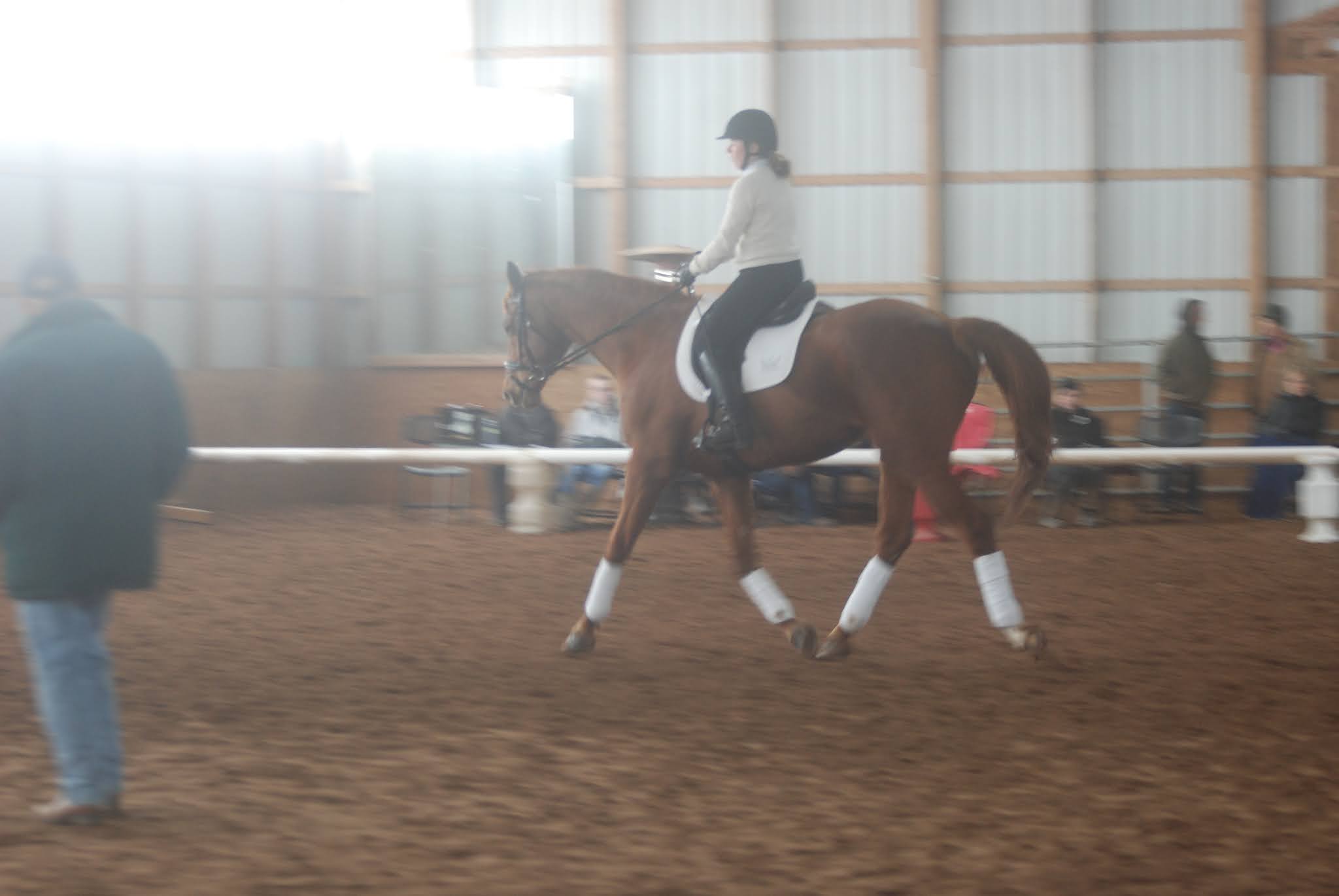
My Grand Prix horse Charrington is always exuberant in the Spring. Luckily my husband is always up for the excitement of those first outdoor Spring rides. Working outside is always a great way to condition your horse, working gentle hills, interval canter/trot and videos taken outside are always more fun to watch.

I've usually already started the horses that have had a winter break back up before this, using the longe line to build their strength and top-lines up before I ride them on a daily basis. Even 2/3 times a week with side reins on the longe line will condition them quickly. Horses have great muscle memory.

Winter months are a good time to reflect on how we can best improve our education and riding skills before the new season arrives. With the flurry of activities of booking clinics, filing show entries, calling the vet in for vaccines and ordering new show gear and fresh saddle pads and tack, it is good to enjoy the anticipation of a better season than last year.

It goes without saying the best way to improve quickly is to have a regular lesson with a good trainer. If you are looking for a trainer there are lots advertised on the magazine here at Catskill Horse and differentiated in the Business Directory by discipline. Not everyone can manage to afford that, but it certainly better to work with someone even once a month than no-one at all. How to make the best of the time you spend in the saddle when your paying for the advice from the trainer? Have a video taken of your ride.

There is a lot more to taking a video than just point and shoot. Focus needs to be on the key points of the lesson so you can easily assimilate those ideas. Watching yourself go around endlessly NOT getting it diminishes your self confidence and serves no purpose. As a competitor and earnest practitioner of Neuro Linguistic Programming (NLP), I am a big believer in all things positive. Having said that if the cinematographer can edit you down a video that captures your 'Ah-Ha' moments, of which there should be a few during any lesson if your trainer is worth their money, these moments will transfer to the other side of your brain if you watch them enough times. This is extremely beneficial for success with improvement. One of the many hats that I wear includes  professional video services ( & photography services) on a limited basis at any clinics/lessons I attend and this is how I always edit them. Sure, I might fancy the video up with fade ins/outs, wipes, etc. but the content is always succinct.

It should be mentioned that before you take a video it is important to ask your trainer/clinician for permission. It may not be O.K. with them to share their usually hard earned knowledge and education for free on You Tube or facebook or others sources. Think of it as protecting their business. If you are a graphic designer, and you design a fresh idea, you do not give it away for free to the entire world. So it is important to be respectful of their wishes ( on a sidebar here, the same reason you should not expect to audit a clinic for free). Many top level competitors that run a proper clinic circuit will not welcome home made video appearances but will be happy for the hosting video professional to take clinic video.
Northfield Farm, Otego NY Dressage Clinic December 2013 with Grand Prix trainer Paul Alvin-Smith working with Joyce Northrrup who is returning to riding after the birth of her son and working on some dressage basics. When you have had a time away from riding it is a great opportunity to start back up without bad habits and gives a fresh start.

At home riding without a professional trainer of course you can do as you wish, and having a friend with unlimited patience, stand and take a video of your ride bearing in mind the points above as to content can be very useful. If you are starting back up as Spring arrives, take your fuzzy beast in his first back to school workouts and see how things improve. Review the videos critically and with honesty. The first time you see yourself riding there will be instant shame, so expect that.

" I am sitting over my hands," "Riding Front to Back," " Not Sitting Properly," etc. etc.
But because you can see the obvious errors they will be the easiest to fix. Then you'll find yourself reaching a plateau of sorts without some extra help.

This could come from a trainer or self education through good DVDs and books. Again select your material carefully and focus on one thing at a time. And here I will give one of our first advertisers a plug - who just happen to have the largest online selection of quality horse books and DVDs with frank reviews too. Check out TheHorseStudio.com The International Equestrian Shop. Just as it is silly to run around auditing every clinic in creation and never riding in front of a good trainer because it is not the way to improve, running around watching every video and trainer method in creation is not helpful either. When a clinician is instructing the riding student in a clinic, it is not just about what they suggest the rider do but the timing of when they make the suggestion and the method of correction if the student doesn't 'get it'. You can learn a lot from following a series of DVDs that takes you on a diligent path from basics to advanced. And just because you are an advanced rider don't think there aren't a myriad of bad habits or wrongly learned riding faux pars that you can't now recognize and re-learn.

When you reach the advanced levels and train with a big name or Olympic trainer etc. you will always hear that you need to address basics. That is true for everyone. So don't be surprised when you look at a video of yourself and say, "Hey - I see what happened but don't know quite what I did wrong."

So use the dull days of winter to start up your education, get some videos of your work in the saddle and evaluate yourself with a keen eye.

Happy Riding!