Monday, August 22, 2022

The Big Ten! Catskill Horse Magazine 10th Anniversary Special


Let the celebrations begin! Catskill Horse magazine is pleased to announce their 10th Anniversary edition is in the works with lots of specials, fun look backs over the past 10 years in a bumper edition.

Press releases on topic with more details about the history of the magazine and where it stands now, as well as what is on offer to advertisers and readers in the bumper edition have been distributed but if you missed them there is still time to canter in and be part of this extra special celebration!


So don't forget to check in! Deadline for promo rates and special offer sign up is September 15th!


Sunday, April 3, 2022

The Bonkers Biz of Running a Horse Boarding Barn?

The premise of running a horse boarding barn seems simple enough. Buy a barn and some property with paddocks for grazing. Install an area outside for riding and charge horse owners to bring their equine partners to enjoy the benefits of keeping their steeds at livery and watch the money roll in. What a bountiful existence.


The reality is that you have to be just a bit bonkers to start a horse boarding operation. 

Top 10 things to know before you begin:

1. Horse owners often know more than veterinary surgeons.

2. Insurance companies and the Spanish Inquisition (Monty Python version) have much in common.

3. Grass only grows once in a field but will grow everywhere else with abandon.

4. Hay and bedding have magical properties similar to the 'Vanishing Spell' in Harry Potter. Just say 'Evanesco' and poof - they are gone without a trace.

5. Clients will always arrive early on days when you are late to the barn for mucking out chores.

6. Supervising services from clients come for free - an added and unexpected bonus to help you through your day.

7. The best trainers are the ones sitting alongside the arena not the one working in the middle.

8. Fitbits and Apple watches don't measure stress levels - the number of glasses of wine you need to relax at the end of the day do.

9. Horses never colic, injure themselves or chew wood when you're looking.

10. If you find any spare time in the day to school your own horse you're doing something wrong.


It is not uncommon for horse barn operators to question why they are offering a boarding service at all. 

Gossiping or fractious owners, minor melodramatics over the smallest issue and the need for constant monitoring of staff that seem unable to offer consistent care or show up on time were not mentioned in the barn management classes you took during your Equine Studies. 

Indeed those expensive educational events seemed to overlook the human component in the boarding business. A degree in psychology may have been a better investment.


But at the end of the day. A very long and arduous day. The reason chosen by many to engage in the bonkers biz of running a horse barn is a simple one. 

The horse. 

Big, small or barely a horse at all, the four legged critters smell the best, snuggle the best, make us laugh, make us cry. They make us feel and feed our soul.

Do you often wonder how people navigate life without a horse in it? With no compass of how much they are missing out on? It is wondrous to consider that for many people, the notion of going out in all weathers to care for an animal that costs a great deal of money and effort to keep, and a sincerely large amount of hard-earned knowledge to understand, train and nurture, is a far-fetched idea.

And I suppose, if you really think about it - we are all a bit bonkers.


Saturday, March 5, 2022

Keeping a Weather Eye on the Hay Market


As the snow starts to thaw and deer arrive back on the hay fields many farmers are planning their 2022 planting program. 

The steep increase in grain price means many hay farmers will think twice about keeping their fields under grass this year.

Diesel costs have skyrocketed, as have prices for fertilizer, machine parts and labor. Of course these price increases don't just affect hay, they affect grain prices too. Due to the war on Ukraine, a country that supplies 12% of the global output of grain, we will see increased in food costs not just for horses, but for people too.

Any hay reserves from 2021 have long since vanished. Despite the increased hay expenses, horse owners have little choice but to pay the premium rates especially if top quality hay is wanted. If like me you are looking for a new horse or two, it might be well to wait a bit, because the ridiculously high horse price market post the Covid pandemic is a bubble very likely to burst, as sadly people are forced to part with their horses as a result of the increased expenses of ownership.

Ulcer prevention, digestive health in general and overall mental well-being in horses are all significantly impacted if hay is replaced by products that offer less chewing satisfaction and less fiber quality and mass. 


At our organic horse hay farm at Willowview Hill Farm, our Catskill hills are already showing signs of Spring grass. The deer are already feasting on our crop. It's funny they go almost nowhere else in the valley to graze. I believe the organic nature of our fields is the reason why. Of course this means sharing our crop production with many 'Bambis'. Cute as they are, my husband worked out the amount of hay that one deer consumes at one point. It was a depressingly large amount from the perspective of hay income to the farm. 


But live and let live I suppose. I am already used to sharing any trees I plant and any shrubs or flowers I dig in to the garden with deer, voles and rabbits.

So the question becomes, should we continue to harvest hay or turn to other forage production. Especially as we have recently retired from horse breeding and simply don't need as much hay supply for our own horses. The amount of overage we sell has increased as a result, but baling small bales is a tremendous amount of work especially for my husband and myself to handle alone. 

One field of hay would easily suffice for our horses' needs. And frankly having more room to ride in the indoor arena instead of having to stack and store hay would be great.

It takes us a solid month of daily work to complete the first cut, and another 3 weeks to complete the 2nd cut. That does not account for the time it then takes to load and sell hay out of the barn throughout the year or service the equipment. Vacations, other income producing jobs such as clinic giving and horse training have to take a back seat when hay season rolls around. And you never know exactly when you'll be able to get busy on the fields so making plans to get other activities done is always a challenge.

 
Of course once the hay is harvested the grass fields are perfect for riding. Cantering around the outside of a field is less enticing than galloping over it. Once the grass is turned under, rocks will appear across the ground surface and if we ever want to return to hay cover then the rocks will have to be painstakingly picked up. The memory of that laborious task still lingers from 20+ years ago.

It's all fodder to ponder. 

In the U.K. fertilizer prices are up to 1300 UKL per ton. Similar increases are expected here in the U.S.A. Farmers across the country are turning to 'liquid gold' to fertilize i.e. cow manure. However, as hay farmers know, cow manure means weeds in the hay. At our farm we use horse manure to recycle and help re-balance the nutrients within the soil, along with organic mineral products such as lime.

The price of all hay will certainly increase again this year. Costs for production are ridiculously high. Horse owners are left with little choice than to pay up if they want first class hay that has been properly cured and managed.

Turns around the field don't come cheap with diesel prices at an all time high. To cure hay takes several rounds of work. The initial cut, a minimum of 3 turns between tedding and windrows and then the baling round. 

So my advice to all horse owners out there or barn managers that have to stock up for their clients' horses needs is to plan ahead. 

For boarding barn operators the hay budget won't go as far this year so boarding barns should think about increasing boarding rates now to cover the extra costs.

Sidebar: Here is a link confirming the above hay prices (focused on alfalfa production) from the USDA


Sunday, January 23, 2022

In The Summer Time ~ When The Weather is Fine

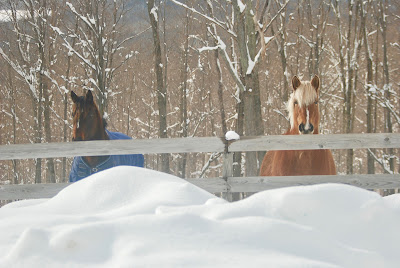
Horses love to play in the snow


It's easy to understand the pleasures of riding horses out and about the trails and working in the arena during warm summer months. Winter - not so much, unless you are blessed to live in an temperate climate where the sun shines and temperatures don't plummet to the negative numbers.

Horses being the wonderful creatures they are, are perfectly content to live outside 24/7 especially if provided with some form of shelter from driving wind/rain/snow. Randomly as their nature dictates, they rarely utilize the shelter of a run-in shed during the coldest of winter weather. But provision of the option to seek refuge from harsh weather makes the equine owner feel better. At least it's there if they want it!


An indoor arena is a boon

There is much discussion about whether it is prudent to force horses to exercise under the direction of a rider during very cold weather. The balance between respiratory damage that may be caused by forced exertion that opens up the airways of the horse and subjects the lung tissue to cold temperatures versus the need to keep the horse fit and exercised, joints moving etc., is a delicate topic.

The key to understanding the cause and effect of damage that could be caused, either temporarily or permanently to the lung tissue of the horse (and possibly also the rider), first requires an understanding of how the respiratory system in the horse is constructed and what Mother Nature has built into the system to warm cold air that is inhaled.

Cold weather riding doesn't just affect the respiratory system, it can also negatively impact the musculature, joints and tendons, feet and heart.

Here is a good summary of important factors to consider and how to determine your horse's individual risk based on not just the temperature, but the difference in temperature from what you horse is used to depending on the region in the U.S.A. where you live.

Dehydration, chill from sweat icing on the horse's coat and many other factors should be carefully evaluated before heading out to ride.

Sometimes a day off for the horse or a diminished work out that does not require as much exertion as the horse is used are better options than riding the horse for the sake of feeling guilty for pausing or halting the schedule of training.

Even pregnant mares love to play in the snow


For horse business owners that rely on income from lessons given at the barn, the likelihood is that very cold weather will result in cancellations of booked activities from clients. To counter this downturn in sales creative horse related activities can be substituted that still provide value for the client but involve less hardship on the horse.

For example, while it may be brutally cold outside with wind chill factors chiming in to deter even the hardiest of individuals from working outside (indeed frostbite might be a real risk), the interior of the barn is usually warm enough to offer a place to work with the horse. Kids can be taught handling and grooming lessons, office or tack room space can be utilized as an educational space for horse movies, games and Pony Club/4H style lessons on tack cleaning, leg wrapping and basic first aid techniques. 

If the facility offers and indoor arena obviously there are more options to ride available. If mounted sessions are not viable consider doing some ground work such as obstacle training and activities that are less taxing on the horse's metabolic system.

For both horse and human proper equipment to keep both warm and to avoid injury from slipping on frozen or wet slippery surfaces is essential for the well-being of both parties in extreme weather.

The transition from one place to another, such as a relatively warm stall to a cold metal indoor, requires careful warm up and cool down times. The length of both should be extended from the norm on cold weather days. This will help give the horse's joints and tendons time to warm up and as a result there will be less chance of sustaining an injury. Handwalking your horse both before and after riding is a good idea in any weather, but is especially important in cold weather.

Always put your horse's needs first

The age and fitness of the horse and rider should also be considered in the equation. Obviously an older horse will be stiffer and will likely suffer from arthritis, while a younger horse may exhibit excitement and exuberance from forced confinement and be hard to control. The work schedule and activities for the horse should be tailored to suit his individual needs.

All that being said, riding in the snow and keeping active during the cold weather is lots of fun and can be very productive.So don't be guilty about taking a day off, but don't overlook the benefits of getting off the couch and hitting the boarding barn, even if you are not a daily caregiver for the horse and required to be there!


Sunday, December 12, 2021

Make Your Horse Business Better in 2022

 The advent of the new calendar year is the perfect time to think about how to improve the bottom line of your horse business. Fresh starts and new horizons beckon, and the opportunity to refresh, reboot and re-imagine your stale business plan is at hand. Why not take the reins and figure out how to make sure your hard work pays off in 2022?


Sprucing up your horse farm and how you operate it is a great start to bringing a fresh perspective to how you are currently operating. Here's a few starter questions to think about:

  • Is your fencing and gate set up at paddocks the best it can be and is it in good repair? Keeping expenses such as vet bills down on the equines in your care is as good as making more money and even more importantly, saves unnecessary suffering and mitigates risk of injury to horse and human.
  • Is the barn clean and tidy with aisleways free of equestrian paraphernalia or is it an obstacle course to be navigated at every turn? Safety first...
  • Does billing for boarding go out on time? Are automatic thank-you letters set up and discounts for early payment given to encourage quick turnaround on bills and improve the cash flow?
  • What is the story with your marketing plan? Do you just post social media about your events and activities and hope that the word gets out? Every business needs an up to date marketing plan.
  • Are you taking advantage of free online marketing opportunities?
  • Have you looked at and listened to feedback from your current clientele? And have you addressed the issues that have arisen?
  • New revenue streams are always an opportunity to improve sales income. Summer camps; dog kennel services; add another riding discipline; employ a professional on site trainer on a commission basis; add a jumping or cross- country course or new service; clinics and Schooling Shows etc. These options all offer means to make more money.
  • How long is it since you researched your competition? Regional changes in services available in your neighborhood could be cutting into your business.
  • Review all running costs of your operation from the prior year. Are there areas where being better organized could have saved you money? For example, buying hay and shavings in bulk by having more storage space.

These are just a few pointers to get you thinking - there are many more areas you can work to improve the business model and build the bottom line.

Free resources such as this magazine, consistently offer good advice on how to build your equine business better. Don't forget to check in regularly for the monthly editions and also the archived articles provide valuable information that can help you grow your business.

Adding new services to your horse barn operation can yield more revenue streams e.g. offering breeding services; start youngsters under saddle ; train horses for others..

As the expression goes, " Work smarter not harder!"

Saturday, October 30, 2021

Winter Horse Training Works Wonders

Horses Love To Play In The Snow


The magic of riding across freshly fallen snow on a sunny day is an experience every rider should enjoy at least once. The same way that cantering on a sandy beach or galloping across an open grassy field lifts the spirit, winter riding can be fun and exhilarating for both horse and human.

When I was a kid growing up in England one of my unofficial riding tutors was Pam, the owner of the farm next door. An ardent horse lover and accomplished rider, Pam advocated the regular interval training benefits for both horse and rider of a good gallop.

" It cleans out the pipes," she said. Even though her horses were sincerely expensive show hunters, there was no equine that she owned that did not enjoy plenty of turnout and plenty of fast work. 

As a horse crazy teen these exciting rides held no worries or concerns about falling off or the horse being hard to handle. A bolting horse was merely a great ride and I learned that as long as you had the space to wait long enough any horse could be brought back under control with some patient cajoling. It sounds ridiculous now of course, as a 'vintage' rider, and a dressage one at that, the idea of bolting around large fields on a 1500 lb animal out of control for periods of time is a dangerous pursuit for all sorts of obvious reasons. But galloping around on horseback in a herd can quickly get out of hand. Ask any foxhunter!

The winter weather in England was never an issue that stopped me riding. Frankly, if you didn't ride in the rain or bad weather you would simply never keep a training program on point. Riding gear included wearing long, almost touching the floor heavy waxed coat that covered you and the saddle and swept across the horse's rump when mounted. Velvet riding caps simply got wet. The rain dripped down your neck, down your boots and without the right riding mackintosh into the saddle from the front. Not comfortable!

Snow however rarely fell. When it did arrive it was an entertainment. Something to be cherished as the country's infrastructure ground to a halt and days off work and school were often given unless the local farmers had the time to plow the country roads out with their tractors. That is no longer an allowed 'help' to the rural community.  

Living in the N.E. U.S.A. at an elevation 2000+ feet above sea level on the side of a mountain in the Catskills of Upstate New York, has given me a different perspective on riding in the winter weather.

The temperatures are much colder than the U.K., the snow much deeper and more prevalent, and the winter weather lasts much longer. 

Winter Riding Tip: Loosening the girth and then handwalking the horse with a cooler is a great way to cool the horse off - the loosened girth allows a slow return of normal blood flow to the horse's back and the cooler will keep the horse from steaming and cooling off too fast.


If you are lucky enough to own an indoor arena, you might think you are all set for winter riding. There's no doubt that this building offers a sincere advantage over outside ring work or trail riding, although it does come with its own issues. Not that anyone should feel sorry for anyone about that!

Sliding snow melt off the metal roofs can cause an alarming 'airs above the ground' experience for the uninitiated, the footing can become frozen and hard or alternatively dry and dusty if the materials and maintenance are not planned for and executed in a timely manner.

Metal structures that are not insulated can also be cold and damp, and windowless indoors can be dark and depressing unless proper lighting is installed and switched on. 

The outside world may be shining brightly with snow, and horse and rider will often still be seen trotting about the indoor at boarding barns, despite the crowded nature of the environment due to overuse at popular riding times such as the weekends.

My advice is avoid that equestrian melee by schooling outside. Powdery snow can offer a great place to practice elevating your piaffe and passage or even collected trot work if you school dressage moves. For the jumper, fences might be out of the question but much flat work for fitness can still be accomplished. 

Obviously the horses' hooves must be properly kitted out to avoid slipping with whatever fits best for your type of work and environment. Snow balled up in the hoof can cause both horse and rider injury if the horse slips and falls. Twisted fetlocks and torn ligaments can also occur. There are plenty of options available to mitigate the risks such as hoof pads, borium shoes and even studs. If you have your horse shod ensure your horse's legs are protected from injury with protective boots made of material that will not hold water.

Barefoot horses should be kept well-trimmed so as the hoof wall does not become long enough to hold snow and ice, and a spray with a non-toxic oil or application of wax to the sole of the foot can help defray snow packing in the hoof. Be careful to avoid the hoof wall during application, as this can cause the horse to slip.

Trail riding in the snow can be tremendous fun but you do need to take due care to stay safe.

It is best to stick to trails you know well so you can be sure to avoid drifts or snow banks that may hide obstacles that could damage your horse. Don't ride on trails during hunting season or late at night/early in the morning when the light is poor.

Moonlit riding is a lovely experience, but stay close to home, hopefully on your own property.

I once fell in a giant hole hidden beneath the snow that was the left by the forest management team that had extracted several trees including the trees' root balls, by the side of an icy trail. The hole that remained had been covered in soil but not compacted. 

My horse fell on his side in the hole, with me beneath him. The soft soil saved me from injury. He carefully extricated himself while I still held onto his reins. My tall boot saved me from a twisted ankle as he pulled me around. I used his legs to pull myself up out of the hole! We were both shaken up but not hurt, and I remounted him and we walked home both feeling both relieved and tense.

Needless to say, avoid icy trails and always ride in company. Take a cell phone for communication or hand held device such as a walkie-talkie if no cell service is available (kids' radio style walkie talkies can reach a decent distance and there are other options on the market that reach much farther).

It is also a good idea to carry a fold up hoof pick just in case you need to dismount and remove a snow pack from a hoof.

Always let others know when and where you are going and when you expect to return. And then stick to that plan. 

Riding in cold weather also requires extra special attention to the horse's well-being in terms of lung health and hydration factors. When temperatures dip below freezing the respiratory system can be taxed especially if the horse is older or if the work is intense. Exercise opens up the alveoli in the lungs of both horse and human to facilitate a better oxygen exchange to the blood. In this state the small ciliary hairs are exposed to the cold air and can become damaged. 

Dress well to avoid frostbite and don't ride on days where wind chill is an issue. Being wet and cold is definitely the fastest way to experience hypothermia. 

Once you return to the barn ensure you put your horse away dry and comfortable. When riding slow warm up and cool down times are a must, and never leave a hot horse steaming in cold weather. Sweat sheets under a warm blanket or coolers can help dry the horse until he is completely fluffed up and ready for either a dry blanket or to go without. 

With careful management riding in the snow can be a truly magical experience. A 3 or 4 inch cover of snow can help help to keep the horse fit, as he has to work harder to make each step. It is also a great photo opportunity to show off your equine partner! 

My late Grand Prix Horse Charlie and I - always working to keep fit!


Tuesday, August 31, 2021

A .org Link Benefits Your Business ~ But They Are Hard to Secure

An established .org business such as the community resource magazine that is Catskill Horse, offers business owners a valuable lift in organic searches to help grow their company profile in the competitive net neutral marketplace.


Most .org domains are non-profit entities, or government owned sites, that are hard to access for backlinks. No two way street as it were. Adding a .org as a link from a site to a .org business adds little value when it comes to SEO.

Catskill Horse offers an enterprising means to not just get your business in front of a large marketplace of regular viewers ( currently over 100K+ per month), it also elevates your website in the organic searches and it is relatively inexpensive to accomplish.

Best way to garner the full benefit is to take a long term or annual contract with a 12x month frequency and take advantage of event feature articles and editorial support with an advertisement. But there are other options too.

In addition to more than 15 horse business categories listed in our Directory Service Guide listings:


 Plus a special section for stallion owners:


And a special section for equine art:


 Look at the categories your non horse-related business can be included under:


" We have special promotional rate offers that run seasonally for 3 month blocks to help folks manage their budget," explains Catskill Horse magazine Editor Nikki Alvin-Smith, " The rates start at just $195.00 so it is a super opportunity for biz owners to improve their branding and sales reach. As always our magazine is here to help grow the community."

While Nikki Alvin-Smith contributes her services to Catskill Horse magazine as part of a community service effort, her 'daily driver' job is as a professional PR/Marketing Specialist/Strategist and Content Writer. Thus her experience helping companies grow their brand and increase their sales and profits provides additional insights that advertisers that support Catskill Horse magazine can utilize to their advantage.

Nikki Alvin-Smith at Dalhousie Castle Library, Scotland


"I write a lot about SMM and SEO. As I call them when writing my column pieces for Nikki's Notes, the two gangsters of marketing. It surprises me how many astute entrepreneurs and even seasoned business managers don't know how to adapt their marketing to address the ever changing Google analytics. It's worthwhile for anybody that is serious about gaining market share to keep abreast of what's hot and what's not."

Listings on the Directory and on the pages is FREE for businesses and details of what information to submit are found on each page. Ask about the current promotions and planned extra bonus features that are coming to Catskill Horse and harness the power of the press to your advantage. 

While a paid advertisement is necessary to garner the valuable .org link to a website, there are other options such as feature articles that focus on the business, event wrap up news features, social media promotion through Catskill Horse various media channels, event coverage and much more. Advertisement design is free.

" Not only is a paid advertisement at Catskill Horse magazine a great way to grow your brand, and improve your sales, it also helps the community at large by keeping the magazine funded. The viewership of the magazine is non-subscription based and free to read. It is a business model that has been employed primarily to help connect horse related companies in the area and promote rural lifestyle. When it was founded 9 years ago, the reach was expected to be mostly regional across the Southern Tier and Mohawk Valley of New York. However, it has grown massively since inception. We have a lot of readership up and down the East Coast, with out of town folks connecting to find places to stay, eat and come enjoy some time Upstate, enjoying all the beauty it has to offer. A lot of NYC folks enjoy reading it and use it as a resource. It has grown to be about horses and rural lifestyle and agri-tourism," states Nikki.

Are you part of "The Merry Band" that is the Catskill Horse? You're invited! Don't be shy to connect.

Please visit www.CatskillHorse.org to learn more.